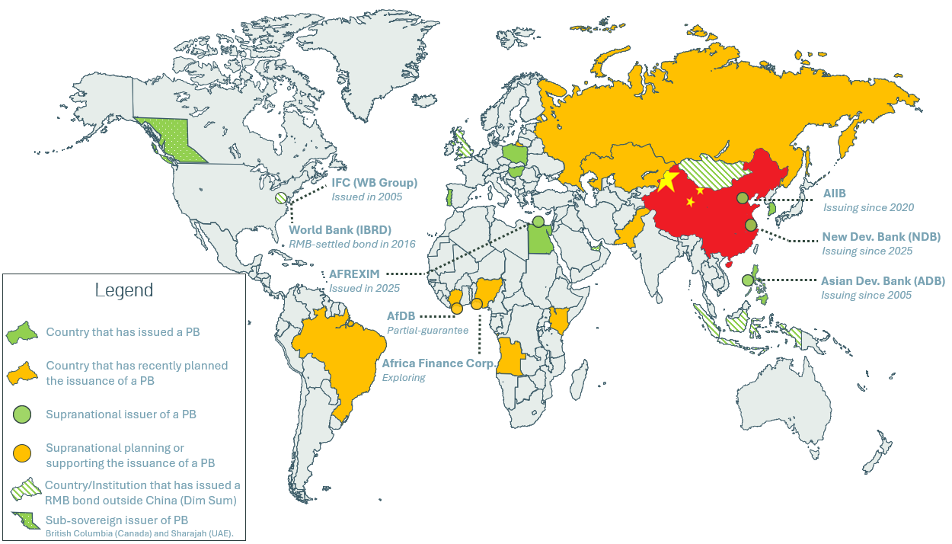
Panda bonds—RMB-denominated sovereign debt issued in China’s domestic market—are rapidly gaining traction among emerging market and developing economies (EMDEs). With Chinese government yields near historic lows and frontier market borrowing costs approaching 10%, the headline appeal is clear: cheaper funding and diversification away from USD markets.
Momentum is building. Sovereigns across Africa, Asia, and Europe are exploring issuance, backed by strong political support from Beijing. As a pillar of RMB internationalisation, Panda bonds feature prominently in bilateral diplomacy and global initiatives such as FOCAC.
But the reality is more complex than the narrative suggests.
This paper examines the Panda bond market from both issuer and investor perspectives, highlighting three key insights:
- The true cost of borrowing is higher than expected.
For EMDE sovereigns, the apparent yield advantage narrows considerably once credit enhancement costs and currency hedging are factored in. Compared to domestic borrowing in local currency, Panda bonds are generally more expensive, not cheaper. The instrument remains competitive compared with USD Eurobond from a strict yield’s perspective.
- Political support is real, but the market remains shallow.
Panda bonds are one tool in China's broader RMB internationalization strategy, alongside other initiatives such as swap lines. However, Chinese domestic investors remain strongly skewed toward top-rated, short-dated instruments. Appetite for sub-investment-grade sovereign debt is extremely limited, making credit enhancement a requirement for all EMDE issuers.
- Scaling up will require deliberate policy action.
Three mechanisms could deepen the market: MDB intermediation, whereby highly rated multilaterals issue onshore and on-lend to lower-rated sovereigns; expanded guarantee frameworks from MDBs or Chinese policy banks; and loan-to-bond swaps, in a Brady-like manner, that would transform parts of China's existing bilateral loan stock into tradable Panda bonds. Each option involves trade-offs and political constraints that the paper examines in detail.
The paper also maps the universe of current and potential sovereign issuers and provides a comparative cost-of-borrowing analysis for three African countries — Kenya, Nigeria and Côte d'Ivoire — that have publicly expressed interest in issuing.
The conclusion is clear: Panda bonds are a promising but not yet transformative instrument, and their potential will only be realised through careful market shaping rather than regulatory reform alone.