

Last month, the IMF announced that it estimated public debt in Senegal at 132% of GDP in end-2024, or more than $43 billion, compared to an estimate 80% of GDP just 2 years earlier. The IMF Mission Chief stated that he had "never seen a hidden debt of this magnitude" in Africa. The forward-looking question is daunting: Senegal is in the midst of a major economic and debt crisis because of this discovery. But the backward looking question is also important: what happened? How could such large borrowings be missed?
The most recent government assessment estimates public debt at $39 billion (119% of GDP) at end 2024[1], including $26 billion in external debt. The World Bank International Debt Statistics (IDS2025) for end-2024, published yesterday, allow us to lift a little bit more of the veil for the external part of the debt[2], and raises new major questions.
This blog uses these newly published data to understand how such large hidden external public debt was missed, by which creditors, and on some consequences for a possible restructuring.
What was missed
The IDS2025 database, compared to IDS2024, is a goldmine to start understanding those missing data. It allows us to say when and from which counterpart country and institutions those loans were missed. Following the brilliant Horn, Mihalyi, Nickol and Sosa-Padilla (2025) paper, which compares various vintages of IDS to infer patterns of hidden debt, we can track when the debt was incurred.
First, it confirms that the new IDS detects the scale of the problem. Senegal’s public and publicly guaranteed (PPG) debt in 2024 is assessed at $25 billion, close to the government latest estimate. Debt stocks start diverging in 2018, but that divergence accelerats in 2022 and especially 2023. By 2023, when the country only reported $17 billion in external PPG debt to the World Bank, it turns out that the actual number was $5.5 billion higher, continuing to increase further in 2024 to $22.5 billion, or 70% of GDP. This means that more than a third of external debt was hidden by the end of 2023. Representing 16% of GDP, this undisclosed debt is drastically above the 1% mean revision found by Horn et al., and equivalent to that of Zambia in 2021.
Figure1 : External public debt as reported in IDS 2025 and 2024
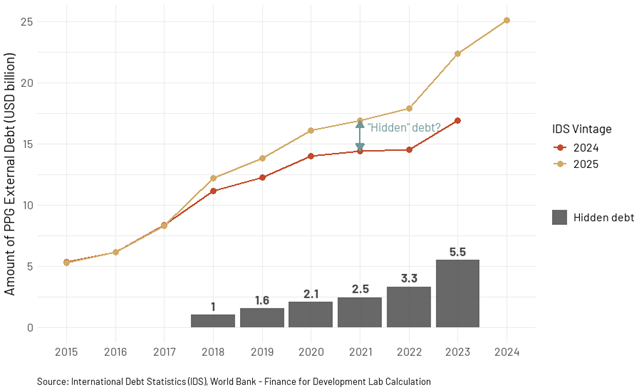
Second, these differences come from staggering amounts of undeclared disbursements: external public debt flows was underreported by $1 billion in 2018 (4% of GDP), a number which declines to $400-500 million in 2018-21, and explodes to $800 million and a staggering $2 billion in 2023, or 6% of GDP (!).
Figure 2 : Loan disbursements as reported in IDS 2025 and 2024
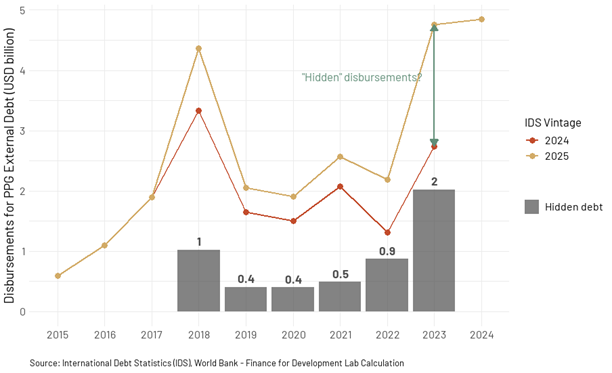
Third, except for 2023, they do not come from “hidden projects” but from “hidden transactions” in known projects. The corresponding errors are much smaller when comparing commitment amounts: Senegal had disclosed the existence and amounts of signed projects, but not that they were disbursed. 2023 is an important exception where the latest IDS data add $1.5 billion in commitments compared to the 2024 vintage. This confirms what the Court of Auditors report, published in early 2025, had shown: that a substantial share of this hidden debt, about 40%, stemmed from undeclared disbursements on projects financed by external partners.
This begs a number of questions. First, which creditors account for the bulk of this undetected spending? And second, why did no alarms ring?
Which creditors?
Bilateral lending explains most of the missed amounts, representing $2 billion of the $5.5 missing billions. They are followed by private lenders at $1.8 billion, and surprisingly, multilateral lenders right behind.
For bilateral creditors, all large lenders to Senegal seemed to have their loan disbursement underestimated. Chinese loans were undercounted by a total of $1 billion, spread throughout the period. France’s loans transactions also have seen significant underestimations, of about $500 million, concentrated in 2020 and 2023. IDS does not allow us to identify lending institutions or the type of transaction (i.e. projects vs. export credit).
Chart 3: Hidden bilateral debt -- counterparties

Notes: Red line is the overall hidden disbursements from bilateral counterparts. We only select creditors with over $70 million in discrepancy over the period, to keep the chart legible. In some years, the difference between disbursed amounts were larger in the 2024 vintage of IDS than in 2025, hence some (rare) negative values.
These differences are surprising. The World Bank and G7 members (and Paris Club non-G7 members) have carried out reconciliation exercises between borrower and lender transaction data in 2023 and 2025. They found relatively small discrepancies, which does not seem to match this chart.
Multilateral and private lenders fare little better. IsDB, Afreximbank and BOAD were the largest unreported loan transactions. Again, those projects were not hidden by any means: commitments data were correctly reported, sometimes even publicly (a $430 million Afrexim loan was reported in the press in 2023, matching the expected amount). In the private sector, French, Ivorian and Chinese banks record the largest amount of transactions which were not properly reported.
Chart 4.A: Hidden multilateral debt -- counterpart institutions
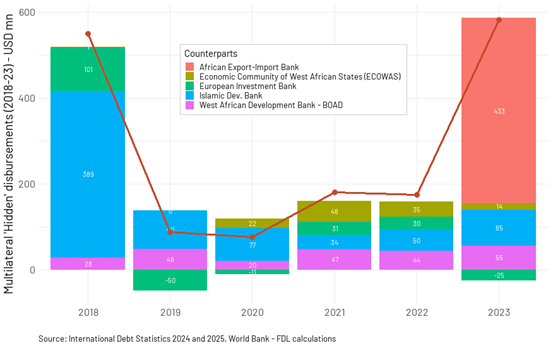
Chart 4.B: Hidden private debt -- counterpart countries
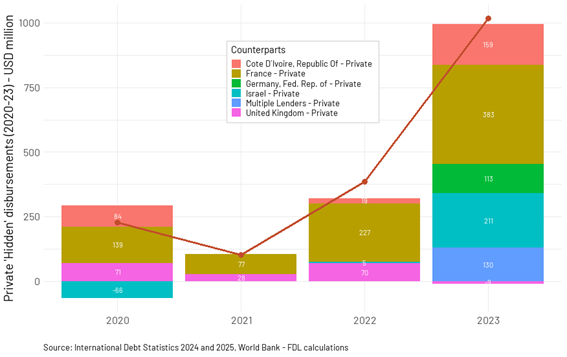
Notes: The red line is the overall hidden disbursement for multilateral (resp. private) counterpars. We only select creditors with over $70 million in discrepancy over the period, to keep the chart legible. In some years, the difference between disbursed amounts were larger in the 2024 vintage of IDS than in 2025, hence some (rare) negative values.
Why were there no alarms?
What are some lessons? First, that the work on debt transparency – including the publication of contracts (#PublicDebtIsPublic ) and transactions is more urgent than ever. Second, this case also illustrates the importance of the world of the World Bank to trace transactions when they occur, and reconcile them automatically with those of creditors (the Automated Creditor/Debtor Loan Reconciliation Platform). The Global Sovereign Debt Roundtable co-chairs report introduced such a system of which was piloted by Indonesia. Accountability is necessary for the debtor, but also for creditors. What this investigation shows is the utter failure of the system to cross validate its data.
The IMF, as the key institution in charge of surveillance, clearly missed alarms, which will require an internal review. Signs of such discrepancies existed, even in public data.
By end-2023, the amounts of signed loans were way too high in Senegal: cumulated commitments between 2018 and 2023 had reached 84% of GDP, the third highest in the developing world. And yet, apparent actual borrowings, which count towards public deficits, spending, and external debt, were high, but more reasonable at 51% of GDP. One would expect that except in fragile context, commitments and disbursements be roughly aligned, but in Senegal they diverged, and very fast. While far from being a definitive proof, those indications could have been hints of rising problems, and allowed more scrutiny.
And now what?
The Senegalese Prime Minister stated clearly that he would try to avoid restructuring its public debt, but with such high level of public debt, it might be a difficult gamble.
If a debt treatment of external debt were to occur, this new data tells us that Senegalese debt is made of a large share of multilateral creditors and a fragmented official bilateral landscape. The ingredients which have made recent debt treatment long and complex are still there.
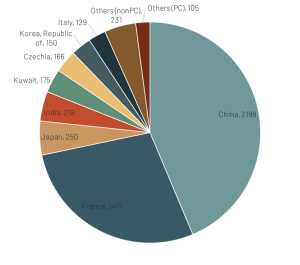
Multilateral lenders represent $10 billion, or 40% of the stock of public external debt according to the latest data, with bilateral, bonds and commercial non-bonded debt representing $5 billion each. Bilateral creditors are split between two large official creditors – China with 43% of bilateral official claims, and France with 30%. Other creditors are small and include non Paris Club members (except Japan at 5%, the others are India, Kuweit, Korea and Turkiye). A fragmented creditor base with significant non-Paris Club lenders could slow resolution on the official side.
[1] Including SOE debt, the IMF estimated total public debt at 132% (November 2025), a number which will fall due to a recent revision in GDP (December 2025).
[2] This note does not look into the domestic part – which is likely to be even more complex.
Remerciements à Mélina London pour son aide et à des relecteurs pour leurs commentaires constructifs.