

Introducing the FDL - MULTILATERAL FINANCE TRACKER
by Simon DESMET & Martin KESSLER
How much did the largest multilateral institutions lend in 2024, at a time where high interest rates put pressure on developing countries? How are they reacting to global cuts in Official Development Assistance in 2025? Are MDBs on their path to raising their footprint as required by the CAF review and other G20 policy ambitions for “Bigger” banks (as well as Better and Bolder, but we will focus on “Bigger”)?
Currently, responding to those questions requires to dig deep into several different financial reports, and even then, data is displayed with delay up to two years. There is no way to assess how fast multilateral development banks have reacted collectively in the past few months and year, how to compare different regions or income level. Typically, financial reports of MDBs include commitments but say little on disbursements, which are essential to track actual flows.
FDL developed a visualisation tracker to fill the gap, compiling several sources in a unified manner. This tracker simply aggregates disparate streams of information from the World Bank, IMF Data Query and International Aid Transparency Initiative (IATI), to provide updated information on multilateral financial flows towards developing countries.
Indeed, the gold-standard database, the World Bank’s International Debt Statistics (IDS), is released every year in December with a lag of one year, making it impossible to analyse recent evolutions by international financial institutions. Shorter term bases, such as Quarterly External Debt Statistics and the Joint External Debt Hub, are more timely: they do allow an assessment on a quarterly basis, but they provide stocks and not flows, and publish with a delay of about a year for most developing countries. They also lack information on grants provided by MDBs.

What do we do?
This project seeks to fill this gap for the IMF and the World Bank and three major regional banks (RDBs): African Development Bank, Asian Development Bank, Inter-American Development Bank.
First, it is a visualisation / data-aggregation project. It collates data from multiple sources in a single, easy-to-use, app.
Second, it makes use of IATI to better model capital flows. Both the IMF and the World Bank provide frequent and timely updates on their project's operation and finance. We use those and aggregate at country level to obtain disbursements in a given quarter. However, for large regional development banks, little to no data is directly available from their website. However, they provide project-level disbursement to the International Aid Transparency Initiative (IATI). We select three large regional development banks (Asian Development Bank, Inter-American Development Bank and the African Development Bank), which together represent more than 80% of total multilateral lending for low- and middle-income countries. Europe and Central Asia (about 60%) as well as Middle East and North Africa (about 70%) are less well covered, given that we could not find relevant information from the EIB and the EBRD which are significant multilateral lenders for those regions.
Aggregating at RDB / country / year level, we find a close-enough correspondence with IDS data on disbursements over 2015-2023, which allows us to trust that our update for 2024 and 2025 is reasonably accurate. Those are thus estimates, and not exact numbers: the methodological companion provides details on how we constructed those estimates, and when we exclude given countries – in particular when the correspondence between disbursements data from IATI and from IDS (which we take as the “ground truth”) differ too much. For debt service, we use projections directly from IDS. IDS provides debt service ahead from existing contracts – hence a one-year ahead projection should be fairly accurate[1].
We will update this tracker as regularly as possible, depending on how frequently MDBs provide data to IATI.
What do we find?
1. Largest gross disbursements to developing countries, but smallest net transfers
FDL – Multilateral Finance Tracker makes it possible to display a clear picture of net external flows in 108 middle-income and low-income economies at multiple aggregation level for a period of 9 years, from 2015 to 2024, $USD and in GDP percentage points. This tool will be updated in the future to account for methodological and statistical improvements, as well as user feedback, which we welcome.
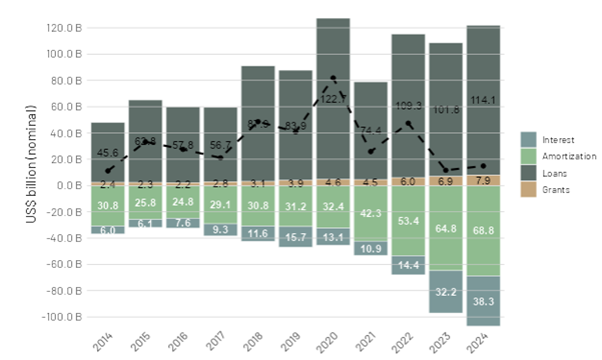
At the most aggregate level, international financial institutions (IFIs) have never had such large disbursement: in 2024, $114 billions of loans were disbursed and $8 billion in grants. Aggregating both, this represents a 12% nominal increase over 2023, below 2020 levels of disbursements, where total disbursements were $127 billion. The picture changes very substantially when considering net transfers, however, that is disbursements net of debt service. Debt service to MDBs has climbed very fast, reaching $107 billion in 2024 (from $68 in 2022). As a result, net transfers from MDBs in 2023 and 2024 were at their lowest point since 2018, with only $5 and $10 billion in additional financing. The IMF provided net negative transfers to the developing world in the past two years (-$10 bns in 2023 and -$5 bns in 2024).
2. What about 2025?
While annual flows will soon be available in IDS, our results allow to describe quarterly dynamics with a lag of about one month only. There are caveats to this: in particular we rely on correct reporting to IATI by RDBs. Also, debt service is inferred from IDS for RDBs, and spread evenly over the year.
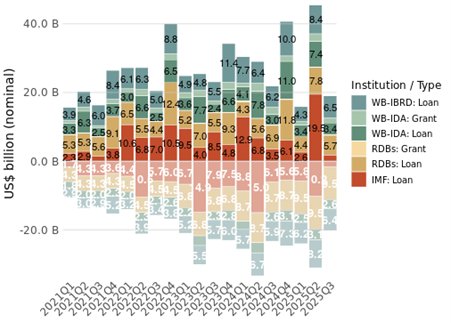
Globally, over Q1-Q3 2025, disbursements have slightly rebounded, especially in Q2 2025 at $43.1 billion. But a large part is due to the IMF, and especially to the $16.8 billion disbursement to Argentina. Without the IMF, disbursements stood at $52.3 billion over Q1-Q3, slightly lower than in 2024, but above that of 2023. The difference is that debt service has increased, making net transfers close to 0.
Annual flows to Low & Middle Income countries
Quarterly flows to Low & Middle Income countries
3. Low and lower-middle income countries receive significant transfers.
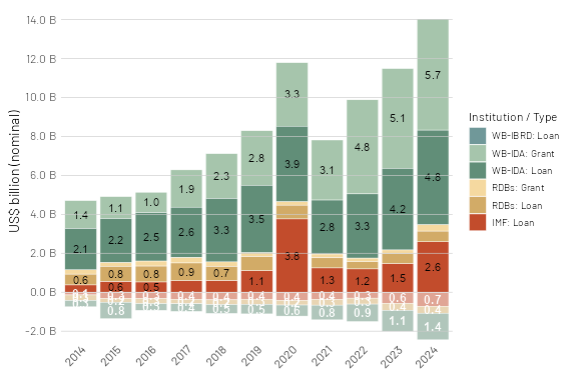
For low-income countries, gross and net disbursements continued to increase rapidly, largely driven by IDA grants and credits. Gross disbursements of loans and grants increased to $14 billion in 2024 (8 bns loans and 6 bns in grants), 32% about the level in 2022 or about 3% of their GDP.
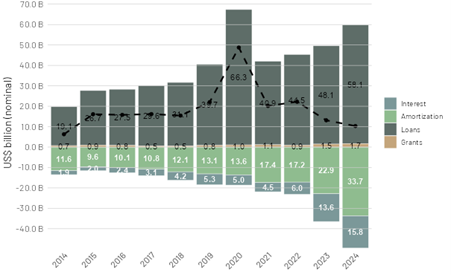
For lower middle-income countries, MDBs disbursed $45 billion in total, or about 0.6% of their collective GDP in 2024, from $40 billion in 2023. RDBs, IDA and IBRD all provided about $14-16 billion in disbursements in 2024, but with rapidly increasing debt service, net transfers declined to their lowest level since 2014.
This trend likely deteriorated in early 2025. Both IDA and IBRD support declined to these countries since 2024, reaching negative net transfers in both Q1 and Q3. As a result, amidst declining ODA, it is likely that multilateral support will be weak, if not negative for this set of countries.
Flows to low income countries by institution
Flows to lower middle income countries by institution
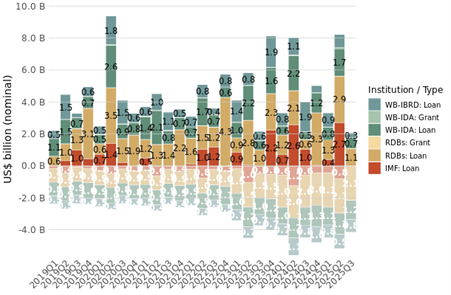
4. Multilateral net transfers are negative in all regions except in Sub-Saharan Africa and South Asia
What drove those declining net transfers from the large multilateral funds? The visualisation tool allows to dig into multilateral flows at any level, from world regions to including individual countries. At the regional level, the largest negative transfers are in Latin America, at about-$10 billion in 2023 and 2024, the IMF reducing its exposure by more than 5 billion over these two years. In percentage of GDP, transfers were even more negative in the MENA region, with about -0.5% of GDP (note that we have a lower share of MDB involvement in the region, since we do not include EBRD nor EIB).
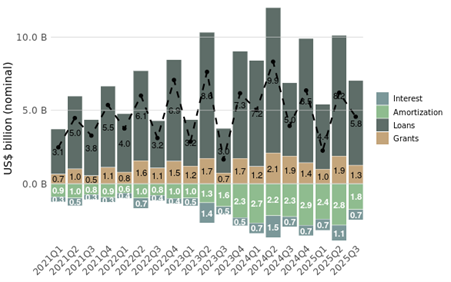
In contrast, net transfers are high and rising in Sub-Saharan Africa, at $23 billion or close 1.3% of the region’s GDP in 2024 due to rising gross disbursements ($36 billion against $26 billion in 2023) and moderately rising debt service. However, early evidence indicates a reversal of this trend in Q1-Q3 2025: loans have declined by more than $5 billion compared to the same period in 2024, and grants by $1 billion.
Quarterly flows to Sub-Saharan Africa, aggregate
Flows to South Asia, by institution
5. What about countries?
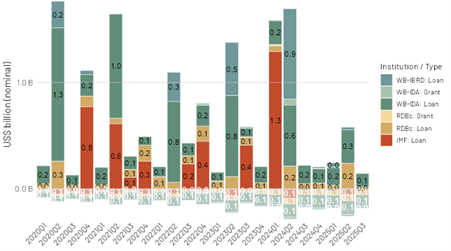
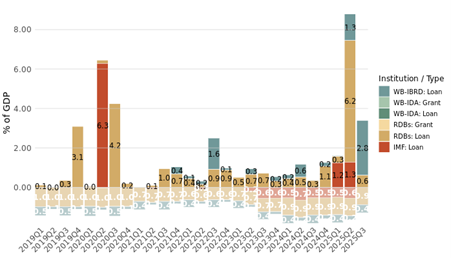
This tool seeks to be useful at country level too. For instance, one can track the decline in multilateral lending after the interruption of the IMF program in Kenya, not only for the IMF itself, but also from the World Bank (IDA and IBRD); the sudden and massive support to Argentina and El Salvador especially in late 2024 and early 2025 including by the IMF but also by the IDB and the World Bank. This tool allows to rapidly identify such peaks and switches, from major institutions to specific countries.
Flows to Kenya, by institution
Flows to lower middle income countries by institution
What now?
This tool seeks to be more reactive for policymakers and observers and provide tools to track both short-term reactions to changes in economic cycles and financing shocks. It is only as accurate and reactive as the underlying data are: the resources that are IMF and World Bank disbursements databases, as well as IATI as a repository. IATI in particular is much more granular, and does not aim at looking at macro-economic trends, but we hope that our analysis does match underlying data
We will aim at updating the data regularly, on a quarterly basis and as new information is published, and hopefully adding other providers if they are available. We would be grateful for your feedback, both from a data accuracy standpoint and use cases.