

Judging by the face of nominal commitments, the World Bank Guarantee Platform is a success: launched two years ago, it has issued $25bn of guarantees in FY2026 alone and already surpassed its initial target set for 2030. This is because sovereign guarantees offered by the Bank are attractive: the new “PBG+” allows a country to cover up to 95% of a commercial loan. However, Yoan Raih, Adil Ababou, and Raph Hurley argue in this new policy brief that it has not targeted where it is most needed.
Only two governments in the poorest segment – Rwanda and Côte d’Ivoire – have benefitted from the reforms. The guarantee is useful, but simply does not reach enough countries. They argue that the Guarantee Platform could be used more efficiently by following three principles: targeting countries in need by broadening eligibility, improving its pricing, and widening its scope.
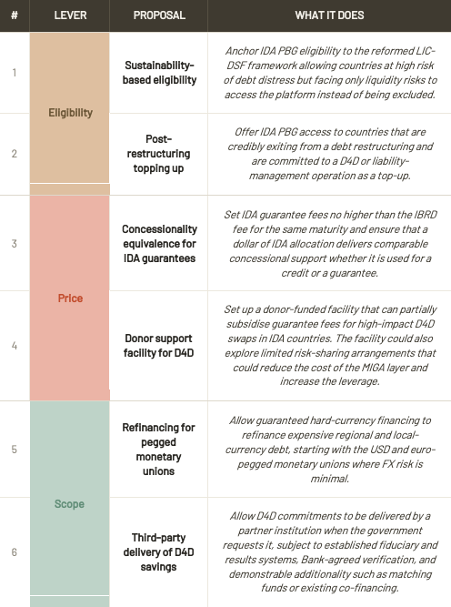
- First, the World Bank should follow its own advice: guarantees are particularly useful to achieve savings for IDA-eligible countries facing liquidity, not solvency, issues. This is the situation where guarantees, and especially Debt-for-Development swaps (D4D), would have the greatest impact. Currently, the platform largely excludes them, requiring a “moderate” or “low” rating on the IMF World Bank Debt Sustainability Analysis.
- Second, the World Bank should make guarantees more attractive for those countries by rethinking their pricing. Even when countries have access to these instruments, the premium is relatively high. IDA countries can pay higher fees than wealthier IBRD borrowers, which goes against the World Bank's pricing logic. Moreover, guarantee fees are paid upfront, just when liquidity is the tightest. It can also leverage donors' appetite for Debt-for-Development swaps by subsidizing the guarantee premium through the platform.
- Third, it should improve its scope in two ways: one financial, the other operational. Local currency debt is often expensive, and using guarantees to refinance it could be impactful. While there are very good reasons to be cautious about refinancing domestic debt, regions with a solid peg to a hard currency have extremely low foreign exchange risk. On the operational side, the World Bank could work with third parties with a solid track record to implement commitments under Debt-for-Development swaps, if they can showcase additionality.