Deepening debt challenges for developing countries: apparent easing, persistent fragilities
Lessons from the new World Bank International Debt Statistics 2025

With lower global interest rates and renewed access to international bond markets, external debt pressures in low- and middle-income countries (LMICs) have appeared to ease in 2024. However, this apparent aggregate recovery masks profound heterogeneity across low- and lower-middle-income countries (LLMICS), with diverging trajectories carrying distinct risks and challenges that will be heightened following the outburst of the war in Iran and the Middle East.
This note differentiates countries along two dimensions: whether they face systemic illiquidity or insolvency risk — assessed through FDL's debt sustainability model projecting flows and stocks to 2030 — and whether they hold access to international capital markets, proxied by foreign-denominated bond issuances in 2024 or 2025.
Through these lenses, four core findings are documented.
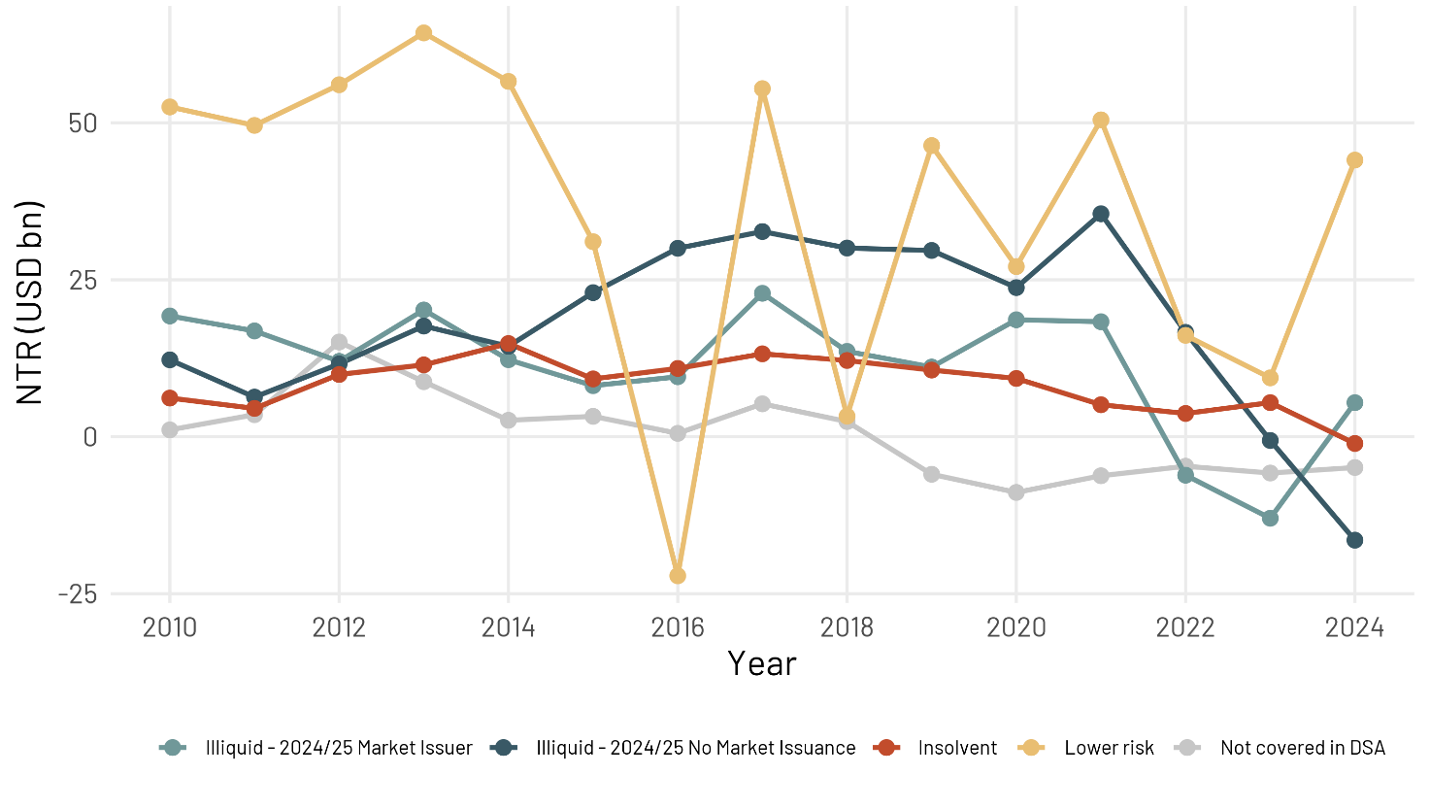
- First, bond market access has become a liquidity divider: illiquid countries able to issue high-coupon bonds achieved short-term relief and a return to positive, or at least less negative, net transfers, while those without access face continued outflows and mounting fiscal and foreign exchange stress.
- Second, this liquidity relief comes at a steep price: average coupon rates of 7–10% translate into rising medium-term debt service, which is worsened by rising costs across all creditor categories — including multilaterals. Moreover, these countries continue to face liquidity shortages, thereby reducing their growth potential.
- Third, retrenchment by private creditors and China is being financed by multilateral inflows that are absorbed by debt service rather than by financing productive investment, creating widespread leakages, particularly for illiquid countries without access to bond markets. Moreover, the rise in senior debt discourages further private flows.
- Fourth, the liquidity squeeze is increasingly a foreign exchange squeeze, which is particularly hurtful to the growth process. Insolvent countries sit at the IMF's three-month import cover threshold, leaving no margin for shock absorption. Illiquid countries without market access show declining reserves, pointing to a gradual erosion of buffers. Among Eurobond issuers, reserve positions appear stronger on aggregate but mask significant heterogeneity, with some countries remaining highly vulnerable.
While detailed data for 2025 are not yet available, similar trends are likely to continue, as Eurobond access has remained highly selective and at a cost well above historical averages. This heterogeneity across countries carries direct implications for the design of restructuring frameworks, the scaling and targeting of concessional finance, and the sequencing of policy responses across the illiquid-insolvent spectrum.