

The Africa Credit Rating Agency (AfCRA) was launched on 7 October 2026 in Mauritius. A privately owned institution with a continental mandate, it enters a field that is crucial to Africa’s financial landscape. Access to capital markets across Africa is often limited, and where it exists, it comes at a steep price. Credit ratings influence both market access and the cost of borrowing - which puts AfCRA in the spotlight.
AfCRA promises to become an integral part of the financial infrastructure needed to mobilise capital for Africa’s development. It aims to rate sovereigns, sub-sovereigns, corporates and financial institutions across the continent, helping to advance African capital markets. Both domestic and foreign investors stand to benefit - and one important outcome would be a stronger connection between Africa’s own savings and investment. This link was at the heart of the 2nd Africa Annual Conference on Credit Ratings, held in Mauritius just before AfCRA’s launch.

AfCRA has made sovereign ratings its initial priority. It has indicated that they will account for around 70% of its business in the medium term, with the share of commercial ratings rising as it expands its services.
This piece focuses on sovereign ratings, reflecting this priority and the key role they play in influencing the ratings and financing costs of other borrowers in the same country.
How can AfCRA make a difference in a market where three international credit rating agencies (CRAs) - S&P Global, Fitch and Moody’s - are currently the main reference for investors in African sovereign debt?
I see two main avenues. One is wider coverage, alongside new data and insight. The other, less discussed but potentially far-reaching, is reconsidering how sovereign risk is assessed, built on rigorous testing of the relative importance of different rating drivers in predicting default. Together, they could deliver ratings across the whole continent, with greater differentiation between sovereigns.
1. Wider coverage, more perspectives
AfCRA is intended to complement, not replace, the major international CRAs. It would extend ratings to sovereigns that are not currently rated and offer an additional, independent assessment where ratings already exist. This would give investors access to a wider range of credit assessments across Africa.
The rating coverage gap is significant. Only 26 of the African Union’s 55 Member States are rated by two or more of the three CRAs. A further nine are rated by just one, with the rest having no rating from any of the three.
AfCRA would also bring new data and insight. Data gaps in national accounts, fiscal reporting and external statistics remain common in frontier economies, including in Africa. In rating assessments, they are typically filled with estimates and, where material, may weigh on the outcome. Improving the availability and quality of data is therefore a widely shared priority, and one where AfCRA aims to contribute, drawing on diverse sources and research on the ground. Being headquartered on the continent, it would also provide a first-hand understanding of national economic and policy developments and their impact on sovereign creditworthiness.
2. A fresh look at sovereign risk
Africa’s sovereign ratings assigned by the three major CRAs are clustered at the lower end of the global rating scale. Of the 25 African sovereigns rated by S&P, 14 fall within the B category (from B- to B+); the median rating is B-. Only two, Botswana and Morocco, receive investment-grade ratings from S&P (Mauritius is no longer rated by S&P but retains investment-grade status from Moody’s). This contrasts with the more balanced distribution of ratings among emerging and developing economies in other regions.
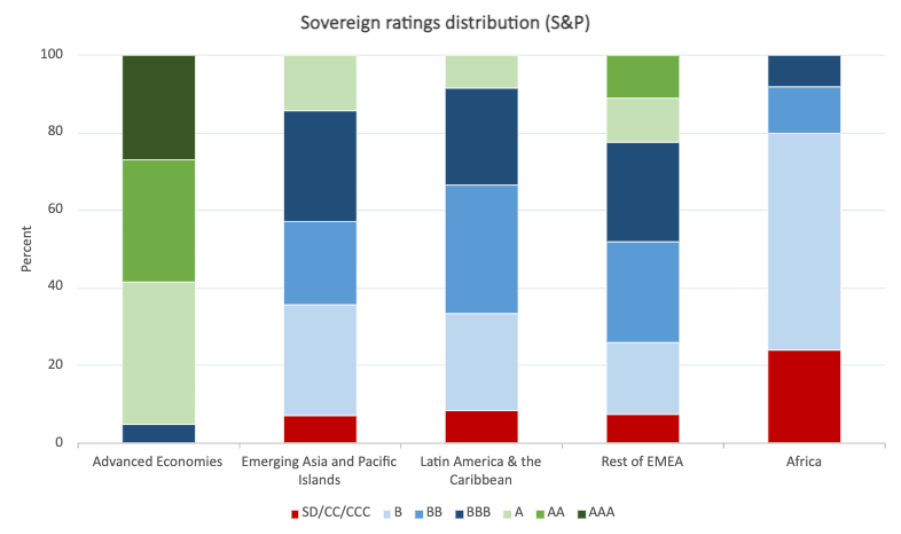
Established sovereign rating methodologies place heavy weight on slow-moving structural indicators, in particular income levels and institutional quality. Many African economies have relatively low GDP per capita and receive weaker institutional assessments, both of which pull their ratings down. My research suggests that these two factors explain more than half of the gap between the median sovereign rating in sub-Saharan Africa and that of advanced economies. More dynamic rating drivers, such as fiscal, external and monetary indicators, matter too, but their contribution to the rating gap is smaller.
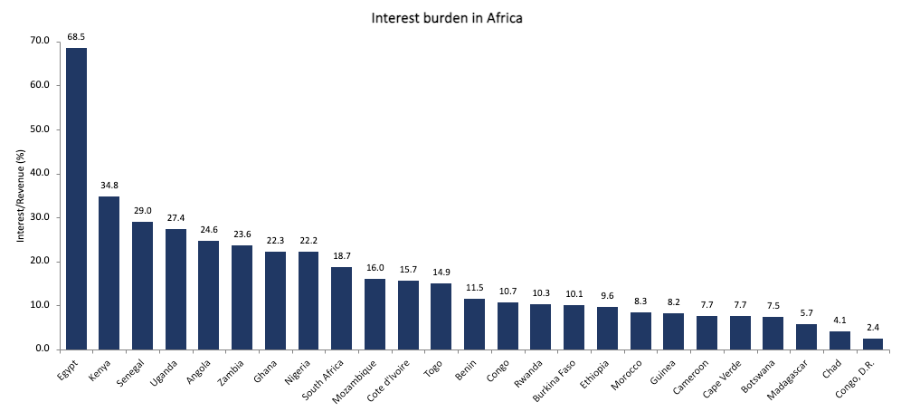
Yet African sovereigns differ substantially in other areas relevant to sovereign creditworthiness, including their fiscal and external profiles - from interest burdens to external liquidity. These rating drivers respond more readily to policy. The dominant role of structural factors, however, can limit how much these differences are reflected in sovereign ratings.
As a new entrant to the field, AfCRA has an opportunity to develop its own approach to sovereign risk. Whether the heavy weight placed on structural drivers is proportionate to their predictive power for default remains an open empirical question – one that AfCRA can investigate. Innovative analytical methods and new data could inform this work. If the evidence supports giving more weight to dynamic drivers, this could lead to greater differentiation between African sovereigns.
AfCRA’s published framework offers some early clues about its approach. Its assessment pillars include familiar dimensions for evaluating sovereign creditworthiness, such as economic strength, fiscal capacity and debt, external resilience, institutions and governance, and monetary and financial stability. It is also exploring new indicators, such as natural resources. Which indicators will enter each pillar, and how much weight each will carry, has yet to be published: these are important choices to watch as AfCRA’s methodology takes shape. The agency’s commitment to continuous testing of its methodologies against observed credit outcomes is promising, as this would help ensure that its assessments remain grounded in evidence about the evolving drivers of sovereign defaults.
Building demand and trust
The opportunities are significant, but to make a difference, AfCRA’s ratings will need to be sought after and trusted.
Engaging sovereign issuers will be one side of the equation. To turn the coverage gap into demand for ratings, AfCRA will need to make the case for a rating to unrated sovereigns and for an additional assessment to those already rated.
Winning investors’ confidence will be the other side. African and international investors alike will judge AfCRA by its independence and the transparency of its methodologies and, over time, by how well its ratings anticipate actual credit outcomes. Publishing its full rating criteria would be a valuable early step. Regulatory recognition will also matter, as it would allow regulated institutions to use AfCRA’s ratings in their investment and risk-management decisions.
Differentiation itself brings a subtler challenge. Depending on how AfCRA weighs various drivers, the relative positions of African sovereigns could diverge from those implied by existing ratings. For investors, that is precisely the value of a more differentiated view; for governments, it may mean adjusting to a new assessment.
Conclusion
AfCRA has considerable potential to expand rating coverage and change how Africa’s sovereign risk is assessed and priced. It can contribute to a more granular understanding of the differences between African sovereigns, drawing on better data, new analytical approaches, and a methodology informed by rigorous testing of the relative importance of different dimensions of risk. This would support more informed pricing, clearer recognition of governments’ policy efforts, and, ultimately, better access to capital across Africa.
Realising this potential will depend on AfCRA’s ability to build demand for its ratings and win investors’ confidence. Independence, underpinned by private ownership, and strong analytical capacity will be central to both. With these foundations in place, AfCRA could make a real difference for Africa - and its work could inform sovereign risk assessment beyond the continent.