

Key insights
Sovereign credit ratings helped unlock access to global capital markets for Sub-Saharan Africa (SSA), but the benefits of wider financing options have come at a price: high borrowing costs and sharp swings in investor sentiment.
SSA countries have long paid a steep premium compared to peers, facing an elevated cost of capital even in a low global interest rate environment. A series of global shocks has pushed SSA’s borrowing costs even higher; interest payments now crowd out investment in physical, human, and natural capital.
While multiple factors influence market access conditions for SSA, the role of ratings has been vigorously debated. The recently published Paper contributes to the debate, addressing two key questions: what are the key factors behind SSA’s low sovereign ratings? And how fair are these ratings?
The unsettled debate over SSA’s sovereign ratings
Sovereign credit ratings are crucial to Sub-Saharan Africa’s (SSA’s) financial landscape, yet debates continue over their accuracy, fairness, and impact. Concerns generally centre on three issues:
- The low level of SSA ratings;
- Procyclicality - swift downgrades of SSA sovereigns in response to external shocks, which amplify financial volatility and exacerbate downturns;
- Asymmetry - quick downgrades and slow upgrades.
Together, these concerns underpin the debate about a perceived bias of major international credit rating agencies (CRAs) - S&P Global, Fitch, and Moody’s - against SSA.
The study’s focus on the low level of SSA ratings provides a compelling foundation for analysis of their accuracy and fairness. Procyclicality and asymmetry of ratings are important issues that merit separate investigation, but they have compounded an existing problem: CRAs consistently place SSA at the bottom of the global rating scale.
Historically, only Botswana, Mauritius, Namibia, and South Africa attained investment-grade ratings, but Namibia and South Africa later lost this status. By the end of 2024, 31 countries in Sub-Saharan Africa had a rating from at least one CRA. The median rating assigned by S&P to SSA was B-, 12.5 notches below the median (AA-/AA) for advanced economies (AEs). Only Botswana and Mauritius retained investment-grade ratings - less than 10% of all SSA sovereigns rated by S&P (Chart 1). By contrast, emerging market and developing economies (EMDEs) in other regions showed a more balanced rating distribution.
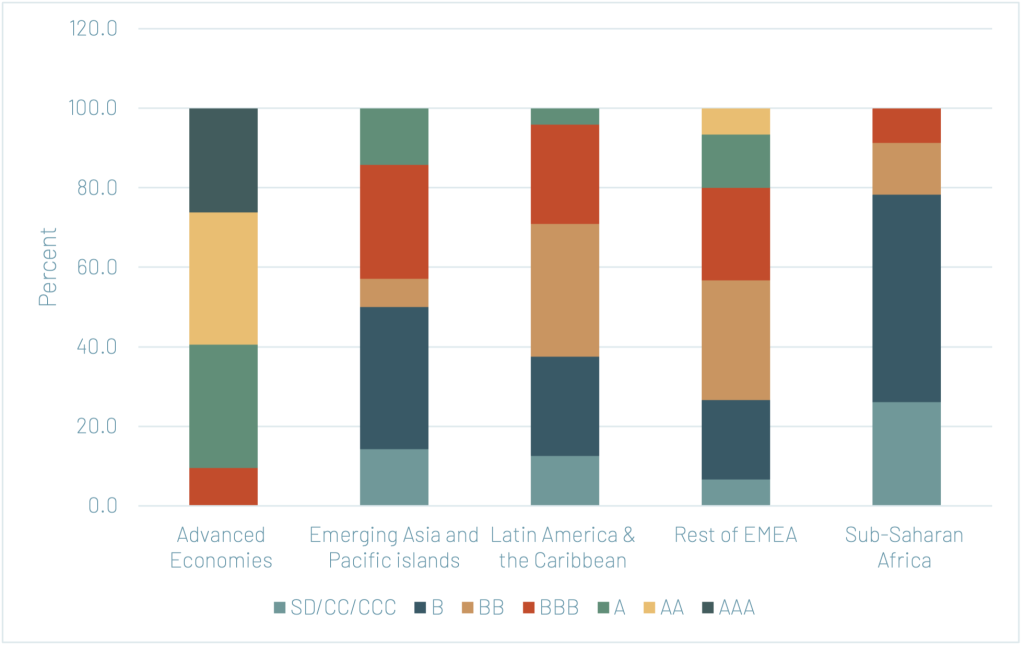
Critics argue that SSA’s ratings are unjustifiably low, which leads to excessive risk premiums and imposes a financial burden on the region. The subjectivity involved in assessing qualitative indicators is often cited as a key reason behind SSA’s low ratings.
CRAs and some experts counter that low ratings reflect the true risk and vulnerabilities of SSA economies. They highlight the use of universal criteria applied to all sovereigns based on publicly available methodologies.
The analysis in the paper points to several key insights.
1. Key factors behind SSA’s low sovereign ratings
Using rating criteria and econometric techniques, including LASSO regression – a novel contribution in this context – the study identifies the key factors behind SSA’s low ratings and estimates their relative impact. The analysis highlights two areas of particular importance: the major role of structural drivers, which anchor SSA ratings at the lower end of the global scale; and specific fiscal and external vulnerabilities, which further weigh on individual sovereigns.
Structural drivers are key constraints on SSA ratings
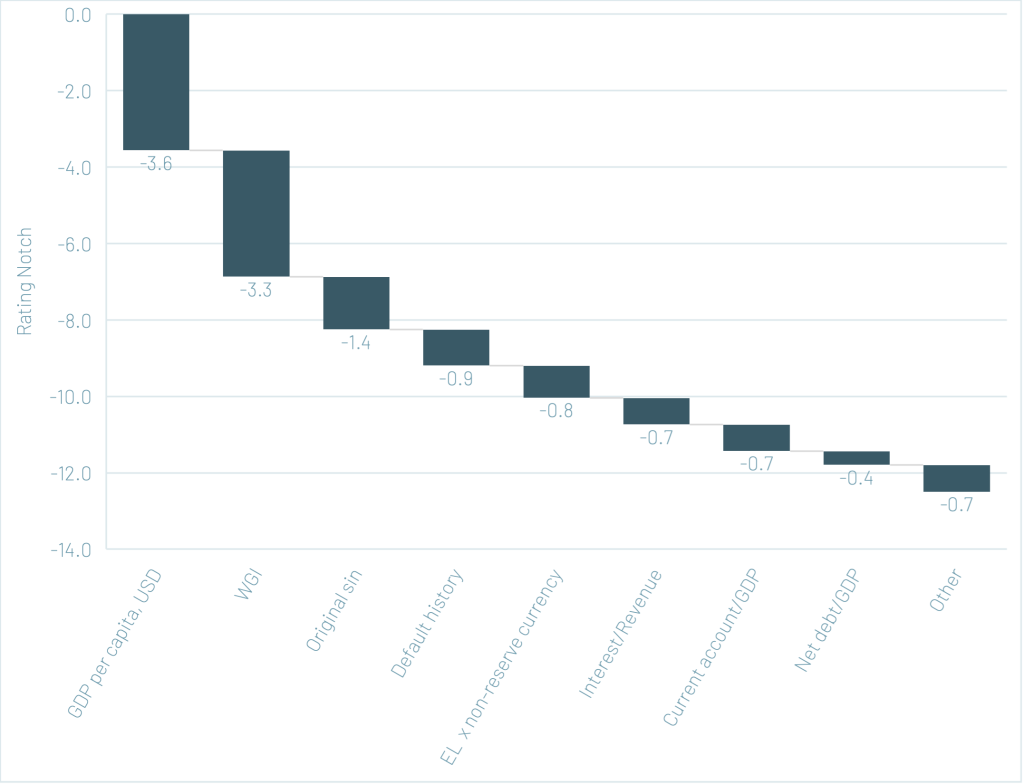
The study demonstrates that GDP per capita and institutional quality are the two most robust predictors of sovereign ratings. It estimates that these two factors alone account for over half of the 12.5-notch gap between the median SSA rating and that of AEs in the S&P sample (Chart 2).
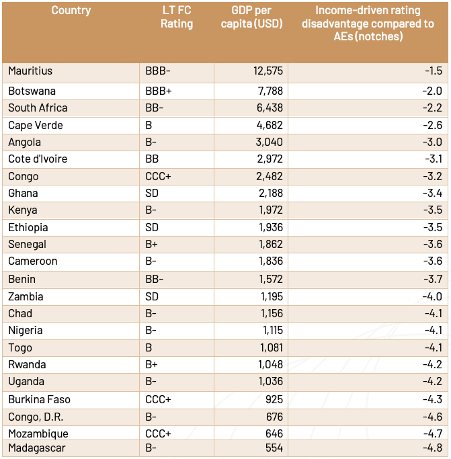
SSA’s “income disadvantage” is a key structural drag on ratings. GDP per capita differences explain, on average, about 3.5 notches of the rating gap with AEs, based on S&P data. The impact ranges from 1.5 notches for Mauritius to nearly 5 for Madagascar (Table 1). Estimates using Fitch criteria suggest a contribution of 2.5 notches from income, and another 1.8 from economic size – a factor closely tied to income.
Weaker institutions also weigh heavily on SSA ratings. The gap between SSA (the median WGI institutional score[1] of 27.6) and that of AEs (87.5) corresponds to an estimated rating difference of over three notches, on par with the impact of income disparities. Other EMDEs also score above SSA, suggesting that weaker governance remains an important structural constraint on regional ratings.
Reserve currency status is another rating driver that benefits many advanced economies, potentially adding another 1.5 notches to the gap (estimates based on Fitch criteria).
Fiscal and external vulnerabilities: significant but not uniform across SSA
Several fiscal variables emerge as significant determinants of sovereign ratings in the econometric estimates. Many SSA countries show significant vulnerabilities on these metrics, although the picture varies across sovereigns, and SSA’s relative standing differs depending on the indicator.
Government debt remains central to the assessment, but the results also highlight the importance of using complementary debt indicators to capture different risk dimensions. Two measures stand out: the interest-to-revenue ratio, which reflects the cost of debt, and “original sin” (reliance on foreign-currency-denominated debt), which exposes sovereigns to exchange-rate risks.
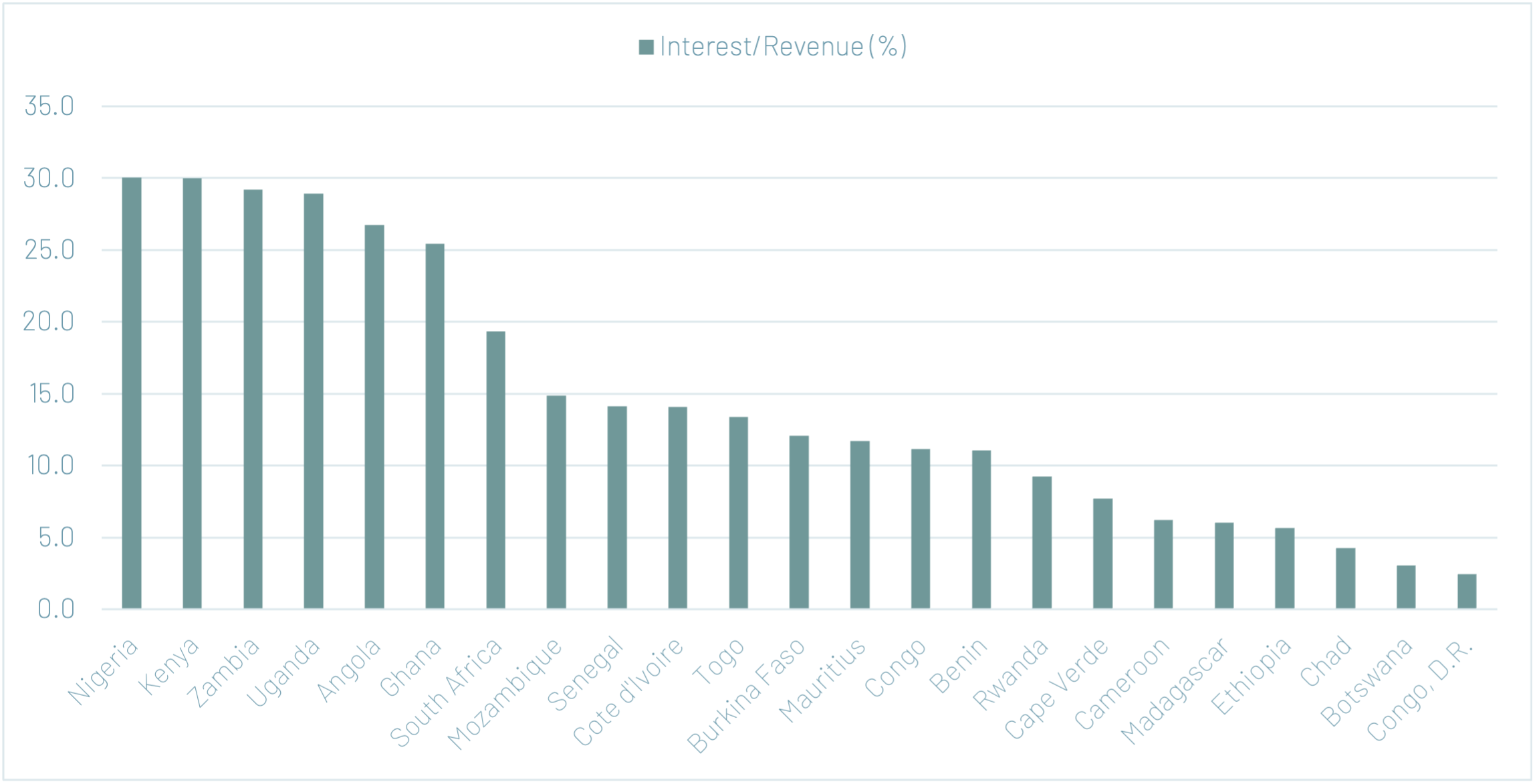
Several SSA sovereigns, including Nigeria, Kenya and Zambia, are spending more than a quarter of government revenue on interest payments (Chart 3). However, the regional median is broadly in line with other EMDEs, and the SSA–AE gap contributes on average only about 0.7 notches to the rating gap with AEs.
The median share of foreign currency-denominated government debt in SSA is 55%. While there are important exceptions, such as South Africa (10%) and Mauritius (20%), “original sin” remains a notable vulnerability for many SSA sovereigns. This contrasts sharply with AEs, where government borrowing is predominantly in local currency, contributing to an estimated 1.4-notch ratings gap.
Weak external liquidity appears to be a key rating constraint for SSA on the external side. The indicator used in the empirical analysis combines two effects: a country’s external liquidity position[2] and whether it benefits from a reserve or actively traded currency, partly overlapping with the structural advantage noted above. While this approach captures the S&P view that external liquidity constraints matter less when a country’s currency is widely used in international transactions, it makes it challenging to separate the contributions of each effect. Both are likely to represent a meaningful constraint for many SSA sovereigns.
2. The complex issue of fairness
The study highlights the complexity of evaluating the fairness of SSA ratings and the importance of differentiating between various interpretations.
Empirical studies of potential bias against African sovereigns are scarce, and two key contributions reach opposite conclusions. Across EMDEs more broadly, the literature on rating bias remains inconclusive.
One key challenge is the lack of a universally agreed-upon definition of bias. In the literature, bias in rating levels is seen either as a systematic deviation of the rating from a country’s relative credit fundamentals or as the uneven application of CRA criteria across country groups. These different approaches have led to distinct empirical strategies and partly explain the conflicting results.
More fundamentally, both empirical strategies ultimately test only whether CRA frameworks are applied consistently. They do not question whether the variables and weights used by CRAs are appropriate benchmarks of sovereign creditworthiness – in other words, whether they accurately reflect relative probabilities of default.
Against this background, the study offers a framework to distinguish between three approaches to assessing fairness in sovereign ratings:
- Whether rating criteria are applied consistently to all sovereigns. This is the most common focus in the literature and policy discussions, where rating bias is typically understood as differentiated treatment of countries.
- Whether ratings accurately reflect the relative probabilities of default. This approach is less explored in the literature and policy debate. If certain variables are heavily weighted in CRA frameworks but are not strong predictors of default once other factors are considered, the resulting ratings may be considered unfair even if the criteria are applied uniformly.
- Whether rating changes align with shifts in fundamentals and relative default risk. This perspective focuses on rating dynamics and whether some countries are downgraded more quickly or upgraded more slowly than others in response to similar changes in credit fundamentals.
The study finds no statistical evidence of a differentiated treatment of SSA sovereigns by S&P. After accounting for income levels, quality of institutions, and other rating drivers, the analysis does not indicate that SSA ratings are systematically adjusted downward (or upward). This suggests that viewed through the lens of approach (i), SSA ratings are fair: S&P appears to apply its criteria consistently to all countries, including those in SSA.
Yet the oversized role of slow-moving structural indicators raises the question about the fairness of ratings viewed from the perspective of approach (ii), if the weight attached to these variables does not accurately reflect the relative probabilities of default.
3. Subjective input in sovereign ratings: a nuanced picture
The findings also shed new light on the role of subjective input in rating decisions. The study’s review of CRA methodologies reveals that such input is embedded across multiple layers of the rating framework and is not confined to qualitative considerations. Table 2 illustrates the breakdown between objective metrics and areas where analysts’ judgement plays a role, spanning both qualitative and quantitative assessments.
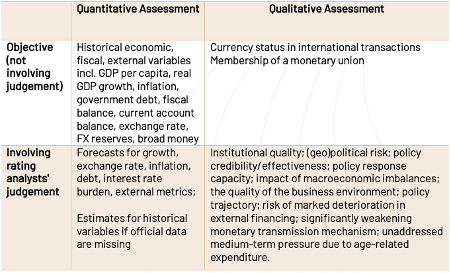
The way subjective input is applied – at multiple points of the rating process and often with limited visibility - introduces scope for bias. However, the findings of this study suggest that it is not the primary reason for SSA's comparatively low ratings. The dominant forces holding back SSA ratings are slow-moving structural factors, in particular lower income levels and weaker institutional quality.
That said, judgment can still significantly influence rating outcomes, particularly in borderline cases. An additional nuance is that discretionary input may itself depend on key macroeconomic and institutional variables, such as GDP per capita and governance indicators, thereby increasing their role in sovereign risk assessment.
4. Implications for policy and future research
For policymakers in SSA, the results underscore the importance of strengthening institutions, broadening the revenue base, and developing local financial markets, but also point to the need for a broader conversation about how sovereign risk is assessed.
For CRAs and the international community, they prompt reflection on whether the weight placed on structural indicators is proportionate to their predictive power, and whether current frameworks might inadvertently embed structural disadvantages for SSA.
More broadly, the findings suggest that the debate on rating fairness may be better served by focusing on the oversized role of structural drivers rather than on possible inconsistencies in the application of criteria.
One key issue is the role of GDP per capita. A country’s income level is a well-recognised driver of sovereign ratings, capturing both an economy’s capacity to absorb shocks and its revenue potential. Yet the question remains: does the weight assigned to income reflect genuine credit risk - or rather disadvantage SSA and other lower-income economies? While it is well established that lower-income countries default more frequently, the key question is whether income remains a significant predictor of default once other rating drivers are taken into account.
Further research is needed to assess whether the heavy emphasis on income and other slow-moving structural indicators in sovereign ratings is warranted. A better understanding of their actual predictive power—and the potential for more forward-looking and dynamic approaches to risk assessment—could help make the sovereign rating system more equitable and better aligned with the development needs of SSA countries.