

With many thanks to Jean Courtial for his help in modelling the value of complex instruments, and Ishac Diwan, Stephen Paduano, Adil Ababou, Ugo Panizza and Anahi Wiedenbrug for their comments
Last week, Ethiopia and its bondholders came to an agreement on the restructuring of its sole $1 billion Eurobond, due to mature in 2024, and in default since end-2023. This does not quite mark the end of the saga – it still needs to be approved by a majority of bondholders, and formally recognised as comparable by the Official Creditor Committee (OCC). But as its co-chairs, China and France, have indicated that they did not object[1], this is seemingly the breakthrough which was needed. This could be the end of a 3-year process, including major debates on COT, which led to the collapse of a first agreement in January 2026 when the OCC rejected a deal between Ethiopia and its bondholders as too generous relative to the one with bilateral creditors.
Is it a good deal? “A good compromise should make everybody equally unhappy”. This quote, alternatively attributed to famous philosophers Larry David or Calvin & Hobbes, describes the recent Ethiopian bond restructuring particularly well. Bondholders have issued a scathing statement[2] and Debt Justice is equally critical[3]. Who is right?
These difficult negotiations also need to be seen in the context of a broader fight on debt restructuring frameworks. A $1 billion Eurobond is certainly small relative to the balance sheet of the funds holding it. The tooth-and-nail negotiations that lasted for 2.5 years indicate that the bondholders’ fight was a statement of principle. Even for Ethiopia, the bond itself was only 3% of its external debt, or 0.8% of its GDP. Ultimately, different proposals had a delta of $150mn, less than a tenth of a percent of GDP.
The bigger questions were architectural, with different actors trying to impose their views upon each other - and Ethiopia navigating those turbulent waters[4]. The IMF perhaps held for too long to forecasts that turned out pessimistic, and did not update them fast enough. Official creditors wanted to show success after the quagmire of Zambia, and went fast, but then sought to impose outdated terms on private creditors. Bondholders tried to obtain a deal based on improved economic dynamics, despite the contraint of comparability of treatment. When this failed, they threatened to sue Ethiopia. All of this was hampered by slow communication of information[5].
There might be an upside: the process was indeed painful and frustrating for all parties involved, but the innovative warrant that emerged might inspire future deals. This blog – which will be followed by a longer analysis of the process and lessons for restructuring – seeks to present the main lessons of the deal.
A bit of background
When Ethiopia initially applied for the Common Framework in 2020, the assessment was relatively simple: its reserves had fallen below 1 months of imports and needed to be reconstituted. Exports were insufficient to restore the balance, and a rescheduling of claims was necessary as debt service was concentrated in 2021 to 2024. Debt stock was not that high (60% of GDP, half external) – and it was mostly concessional. The civil war in Tigray – in addition to its immense human toll, one of the deadliest in recent history, with over 600 000 casualties – also caused the economic situation to deteriorate considerably. Reconstruction was necessary, but was hampered by the debt burden.
After the conflict ended in November 2022, restoring economic stability was an important objective, and it required restarting an IMF program and restoring debt sustainability. After two years of negotiations, the adopted program included a set of major reforms, centred around a devaluation of about 100% and floating of the currency. It was approved in July 2024, with debt restructuring as a precondition, and with two objectives: pushing debt service further in the future for immediate liquidity relief, and a small, but significant stock relief.
- The country required $10.5 billion in financing from 2024 to 2028, of which the IMF would provide $3.5 billion, the World Bank and others $3.8 billion. Debt needed to be reworked to reduce new debt service by an additional $3.5 billion in that period.
- And more controversially, the Debt Sustainability Analysis implied that the present value of external debt at the end of the program would be too high to restore sustainability. Exports were projected to rebound from $13 billion in 2024 to $19 billion in 2028, while the present (discounted) value of debt was projected at $29 billion. The ratio to exports would have reached 154%, above the 140% it considered as safe (allowing Ethiopia to be rated as "moderate risk of debt distress"). While small, this breach was at the center of the 2 year controversy that ensued.
A controversial process
Official bilateral creditors had formed a committee (“OCC”) as early as 2021, co-chaired by China (which held $7.4 bn in loans, already rescheduled under a previous agreement in 2018) and France (the Paris Club collectively owned $2b in loans). Under pressure to show that the Common Framework was able to provide fast and sufficient debt relief, they accepted the IMF’s analysis and provided financing assurances in July 2024, followed by an Agreement-in-Principle in March 2025, setting out the terms of the restructuring, and putting in stone the necessity of a haircut in the value of debt.
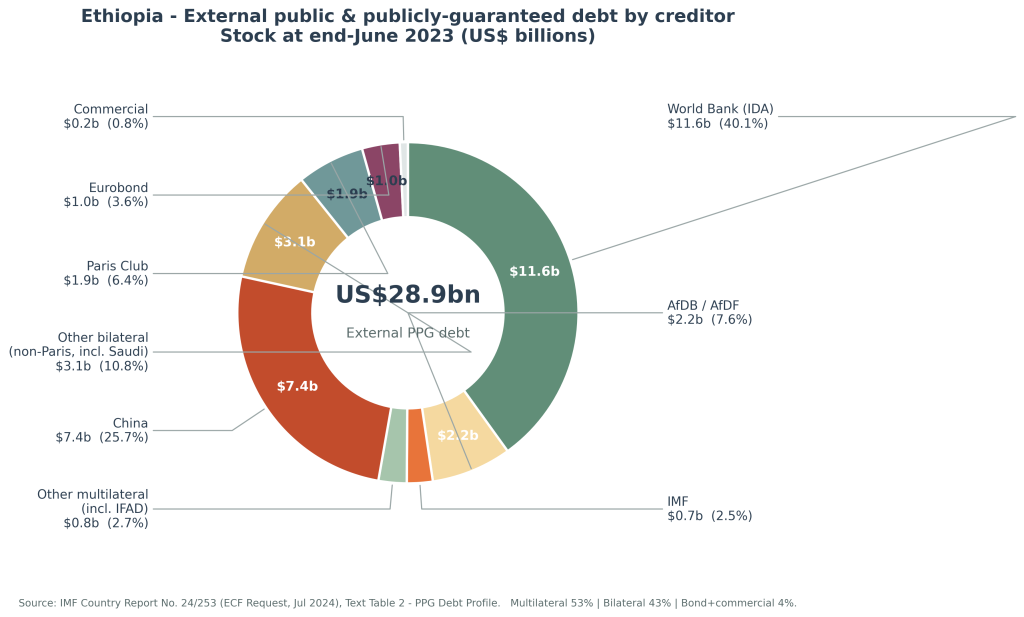
Bondholders vehemently disagreed with the process. They held a minor claim on Ethiopia - $1 billion, or 3% of external debt. A smaller claim can provide leverage: if large creditors settle and debt becomes sustainable, a small creditor can receive its claim in full. The purpose of the comparability of treatment principle is precisely to avoid such free-riding, and became the center of the controversy.
In end-2023, Ethiopia had defaulted on its Eurobond due in 2024, under pressure of the OCC which had granted a standstill while the IMF program was negotiated, and did not want other creditors to be paid in the meantime. Bondholders were also convinced that the IMF program was low-balling exports figures, and that the value would quickly rebound to levels that would not show any need in reduction in the present value of debt: a simple rescheduling of claims would be sufficient.
The bondholder's strategy was thus to hope that the official sector would then either revise their deal or be lenient on comparability. In mid- to late-2025, it became clear that their analysis was correct: the IMF forecasts had indeed been too pessimistic, especially on exports (which was the most binding indicator of the capacity to repay). Led by a higher-than-expected volume of gold exports combined with a sharp rise in gold prices and a comparable boost in coffee exports, Ethiopia’s overall goods exports were twice as large as the IMF had expected just a year before. The sequencing of IMF reviews - when the macro-fiscal framework gets formally revised, based on new data - were seen as opportunities to acknowledge these changes, but once set in stone by the OCC agreement, the principle of Comparability of Treatment implied that any deal between bondholders and Ethiopia would be anchored in past macroeconomic assessments, not the most current one.
A first settlement reached between Ethiopia and bondholders in January 2026, provided a reduction of the bondholders’ nominal claim of 15%, excluding past due interest. It also added a Value Recovery Instrument (VRI) that was tied to Ethiopia’s good exports, with an upside of $180m if they outperformed the IMF’s assessment. Overall, this would make the overall deal equivalent to no haircut. But by the time this deal was reached, Ethiopia was very much on track to outperform the IMF’s original assessment. In turn, this made the bondholders’ deal in violation of the CoT with respect to the official creditors’ deal.
When the IMF subsequently published its review in January 2026, it acknowledged the reality of improved growth and external conditions and — technically — no need for haircut-based debt relief. Yet since the OCC had already agreed to debt relief, “comparability of treatment” required the same from private creditors. The OCC rejected the private creditors’ deal, sending Ethiopia and its bondholders back to the negotiating table. Bondholders chafed at the official creditors’ rejection of their deal and initiated legal proceedings — threatening to sue Ethiopia for full repayment of the defaulted Eurobond
The threat of litigation was always just a threat to put pressure on the official creditors. In the background, negotiations between bondholders and Ethiopia continued. In May 2026, another round of negotiation failed, this time rejected by bondholders as too stringent. The Ethiopian proposal entailed a lower nominal reduction of 12%, but payments would be more backloaded toward 2029, and did not include a recovery instrument. The bond would be amortized in 4 instalments, until end-2029. The rejection set off another round of legal threats.
The agreement
Only one month later, a final deal was reached. In terms of process, it was validated by the IMF as matching the parameters of its program and by the co-chairs of the OCC as comparable, before its publication. The road does not quite end there: other bondholders have to approve, other OCC members as well. Other official creditors such as the UAE still need to reach an agreement. Nevertheless, it does seem that Ethiopia is not far from a full settlement on its debt stack.

The final agreement is halfway between deals rejected by the OCC in January and by bondholders in May. It has two parts: a new bond, which is identical to the one proposed by Ethiopia in May, plus a warrant providing some potential upside to bondholders. The new bond has a nominal value of USD 880 million (a 12 percent nominal haircut), a 6.15 percent coupon, amortisation through July 2029, full immediate payment of the USD 99 million in past-due interest plus a long-coupon of USD 57 million covering 2024-2026, and a 0.5% consent fee. At a 5% discount rate, this represents about 10% in present value loss.
An innovative add-on: the new money warrant
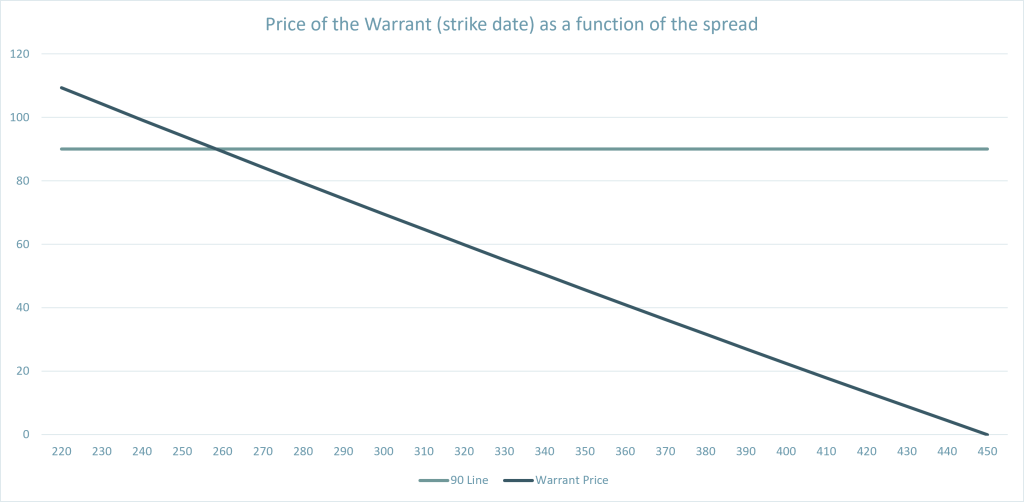
The main addition compared to the May proposal lies in the “New Money Warrant”, a separate, tradable security granting holders the right, but not the obligation, to subscribe at par to a future Ethiopian Eurobond (up to USD 1 billion, allocated one-for-one against existing holdings) carrying a coupon fixed at 450 basis points over six-year U.S. Treasuries at the time of issue. The future bond would run seven years with a six-year average life. Whether exercising the warrant - buying this bond at par - is valuable or worthless depends on Ethiopia’s borrowing conditions at the time of the strike. Its value is capped: it can be bought back at a maximal price of $90m (the actual price is set by a determination agent, but that part of the deal is not specified). In other words, warrant holders get the right to decide to trigger the issuance of a new bond but if Ethiopia does not wish to issue it — presumably because it can issue a vanilla Eurobond within 450 basis points — it could redeem the bond by paying the bondholders $90m.
The principle of the warrant is elegant, as it is based on market indicators rather than more ambiguous or manipulable triggers. The warrant holders will exercise it if they estimate that 450 bps spreads is a better-than-reasonable compensation for their risk. In mid-2028, there will not be a market signal to guide this assessment, so it will come from ratings or market views. In a way, it is akin to a VRI: if Ethiopia is doing well, its (virtual) spread will be low, and the warrant gains in value. Back of the envelope calculations indicate that the value grows linearly as the risk premium falls: it reaches $90m around 280 bps (which would be 6.8% with current UST yield). The elegance comes from the fact that its upside is not based on manipulable values, or with poor correlation with actual ability to pay.
It avoids the pitfalls of regular VRIs. In the recent past, the Zambia deal was passed on the World Bank/IMF composite indicator, an opaque, manipulable and non-continuous assessment, perhaps the worst imaginable. The deal with Sri Lanka includes a bond whose value varies with GDP expressed in USD, which could be poorly correlated with actual capacity to pay. The initial VRI proposed in Ethiopia was linked with goods exports value in USD. This was technically sounder than the Zambian and Sri Lankan VRIs as it is a more natural metric of capacity to repay, but it was still imperfect. Bondholders were tying Ethiopia’s debt service to the one line item that was clearly rising. Moreover, Ethiopia would forfeit the highs of a commodity cycle over the coming years, as rising gold and coffee prices would trigger higher debt service, and subsequently suffer the lows of a possible commodity price fall.
In the case of the New Money Warrant, the structure is natural. The warrants avoid such difficulties: markets will look through the risk at a 6 year horizon, and as imperfect as they are, they assess risks in a way that will reflect Ethiopian probability of default. If exercised, those warrants will provide expensive, but useful liquidity to the government, after the end of the IMF program. These qualities could make such an innovation durable for other restructuring cases.
Yet, it is not without problems, either: the spread where they gets activated is too high, the instruments will be illiquid and might lead to litigation. A spread of 450 bps is probably too high: currently, it would price above Nigeria (7.5%, or 350 bps above UST) and close to Kenya (8.5%, 450 bps) and just below Bolivia (8.8%, 480 bps). This corresponds to about B to B- rating, which is where Ghana emerged from its restructuring[7]. It will also be a complex instrument, only traded among a small group of specialist funds, leading to distortions rather than a useful indicator of country risk it would ideally be. Finally, some terms are still to be determined, including, importantly the pricing mechanism. When and how the warrant can be bought back, and when and how it can be exercised could lead to tensions.
Is the deal comparable?
To a certain extent, yes, although it depends which concept of comparability - especially of the way one counts NPV reduction - one uses. CoT is a mix of three criterions (cash flow relief during program period, extension of maturity of the claims, and loss in present value), and there has always been trade-offs between them. Usually, for instance in the case of Zambia, bondholders provide less cash relief (they like to be paid upfront) but accept face value haircuts.For Ethiopia, because the bond was maturing during the program, any extension reduces cash flow during the program period[5]. As a result, the key question was how much NPV loss they needed to provide to be comparable with the 12.5% provided by the OCC. In May 2026; bondholders had rejected the offer of a 10% loss (see table below, which looks at each variable in difference recent deals under different scenarios). This 10% is estimated using the value of the original bond including all past due interest capitalised at the original interest rate of 6.6% until the date of the agreement. Others, such as Lazard, argued to use a more "legalistic" option whereby the initial bond is valued at its face and PDI, but only until a reference date (default for instance), not the date of restructuring. Under such a convention, the actual PV reduction would be smaller, at about 2%.
Accepting the current convention and even adding the warrant, the OCC probably estimated that in the upside of a cash payment of $90m in 2028, there was some (small) NPV loss of 3%, sufficient to match the fact that the debt service reduction during the program was larger for bondholders. Official creditors provide slightly less cash flow relief, so a small difference on the other side seems reasonable, but shifting to a concept of comparability with more advantage to concessional lenders could be useful.

Conclusion
The deal will inevitably leave most stakeholders unfulfilled, but perhaps most importantly the Ethiopian Ministry of Finance will breathe a sigh of relief that the sword of Damocles — the threat of litigation and creditor attachment that loomed over its current rebound in growth — has been removed.
The natural question that emerges from the case is how all of this may be avoided in the future. There are a few ways to answer that.
The first answer is something of a throat-clearing exercise: low-income countries should put in place better macroeconomic policies, creditors should be more judicious, and debt pressures should be relieved before they spill over into debt crises.
The second answer pertains to the process for organizing sovereign debt workouts. A faster disclosure of the COT parameters of agreements with the official committee, as recommended by the Global Sovereign Debt Roundtable at its April 2026 meeting, would have helped. The Setser-Hagan proposal for parallel, rather than sequenced, negotiations would have been helpful as well. VRIs can be helpful, especially in volatile contexts or where views around the IMF baseline differ sharply, but they will fail if they are simply designed as a way to offer an almost-certain upside to investors, possibly poorly correlated with actual improvement of the ability to pay. New money warrants are an innovative avenue that could help, but raise additional design questions, such as the appropriate spread.
The third answer pertains to the climate of fear that creditors were able to create by threatening legal action. The UK’s sovereign debt regime might need some improvement, but as argued by this ODI report, broad legislative proposals would be difficult to implement, and miss their objective. They propose narrower fixes, such as automatic stays of legal proceedings while good faith negotiations are ongoing. This would enhance borrowers' protection, while putting current sovereign debt regime in the UK in step with the US.
[1] Cautiously though: "[they] provided their non-objection, subject to approval by the wider Official Creditor Committee.”
[2] Among choice furious quotes by the committee: “[The] process to have exposed broad flaws in the architecture of sovereign debt restructuring “ (...) and on the IMF: "The Committee's assessment is that the commercial debt restructuring process in Ethiopia was neither quick nor fair. Nor, more importantly, did it advance the interests of the citizens of Ethiopia. The IMF performed its assessment of Ethiopia's debt relief needs poorly. "
[3] “Bondholders have successfully used the threat of legal action in the UK to wring more money out of the Ethiopian people.”
[4] During #DebtCon7 in Paris, the head of the Zambian Debt Management Office quoted the African proverb: “when elephants fight, it is the grass that suffers"
[5] For instance, an Agreement in Principle of official creditors in March 2025, setting out the main parameters of the deal. But it took 6 months for private creditors to know what those parameters were, and their publication occurred in October 2025.
[6] The FDL team is confused as how to reach 48% - which seems to exclude the $300m payment on July 15th, 2028. Yet, the IMF program comes to a close at the end of July.
[7] Unlike the VRI agreed in January 2026, which was “symmetrical”, but the downside scenario was so unlikely that de facto it could be considered as irrelevant.
[8] Using OAS arrives at slightly lower values – in this case, 450 bps would be closer to Congo, Ecuador and Argentina, all rated B-