Bending the Climate Change Curve by Blending Finance:
What is the Real Potential Value-Added of Guarantees?
The investment needs for mitigating and adapting to climate change are substantial and challenging to finance for emerging markets and developing countries (EMDEs), particularly for the low- and lower-middle-income countries (LLMICs) among them. Guarantees by national and international public entities are often touted as a solution. But most estimates of the additional financing mobilized this way are not realistic. To genuinely add value, guarantees must address specific contractual problems, overcome economic and financial frictions and distortions, and address market failures on the supply and demand sides of financing.

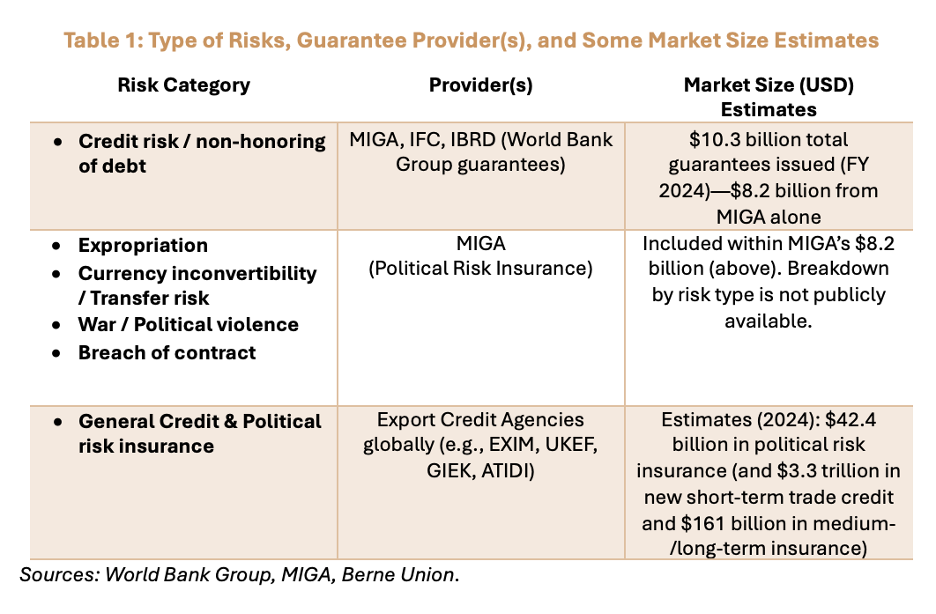
While markets for guarantees, including for climate finance, exist, they are small (Table). And there are very few analyses that assess how using guarantees could overcome external financing problems. The best framework to start from is the Modigliani-Miller paradigm of the irrelevance of financial structures. Using various strands of literature and drawing on real-world experiences, one can then organize why financing may not be available for or only at too high a cost to LLMICs, and what to do about them, in four groups, two each on the supply and demand side.
-
Supply side:
A. Regulatory biases and means to correct them
B. Market mis-pricing biases, and means to correct them
-
Demand side:
C. In- or poor ability to diversify and monitor some risks, and using or designing institutions that can bear or reduce some risks better
D. Too small scales, and how to enlarge financing in ways that provide economic gains
Having organized the arguments, one can turn what to do, applied in this paper to climate finance, either for adaptation or mitigation. It follows that true additionality requires quite a different approach compared to existing use of guarantees. Most importantly, a much greater pooling of financial (and human) resources and more standardization of guarantees (and associated resolution mechanisms) are necessary. Specialized agencies such as MIGA, working with other Multilateral Development Banks and Development Finance Institutions, need to greatly increase their role of guarantees in climate change financing, even when working within existing accounting rules and capital adequacy frameworks. Additionally, the focus needs to shift from banks towards financing by institutional and other long-term investors, such as sovereign wealth funds.