

By Abdoulaye Ndiaye (NYU Stern School of Business) & Martin Kessler (FDL)
A Strategic Compass for Navigating Senegal's Debt Crisis

Senegal enters 2026 with a soaring public debt and very limited options; there are no “good” options left on the menu. In this note, Abdoulaye Ndiaye and Martin Kessler aim to clarify the feasibility and desirability of two possible paths. The first is to avoid restructuring and try to refinance on a large scale while maintaining an extremely tight fiscal stance for a prolonged period. The second is to pursue an IMF-supported restructuring of bilateral and private external claims under the Common Framework, to reduce short-term debt service and make the necessary fiscal adjustment less self-defeating, while seeking to protect regional lenders and the WAEMU financial system from destabilizing losses.
The “no-restructuring” path should be viewed as a narrow corridor rather than a robust strategy. Even if it can succeed under favorable assumptions, it requires two things happening at the same time: (i) a large enough consolidation to reassure creditors without undermining growth and revenues, and (ii) sizeable refinancing at unusually low rates from partners willing to take sovereign risk on a large scale; conditions that may prove politically difficult to sustain. The rollover calendar also makes delays costly. External payments begin to come due in a concentrated fashion; starting with the Eurobond amortization in March 2026; and continued reliance on short maturities and collateralized structures risks tightening the sovereign–bank relationship and shifting the problem onto the regional balance sheet.
The consolidation required to meet sustainability criteria is very hard to achieve. Cutting 10 percentage points of primary deficit in 3 years has rarely been done, outside the context of countries with huge benefits from natural resources, much larger than Senegal’s oil and gas revenues. It would also need to be maintained in the long run: few countries, and none in West Africa, have been able to maintain primary surpluses over several years as would be required.
Chart: Consolidating would require major changes in expenditure and/or revenues

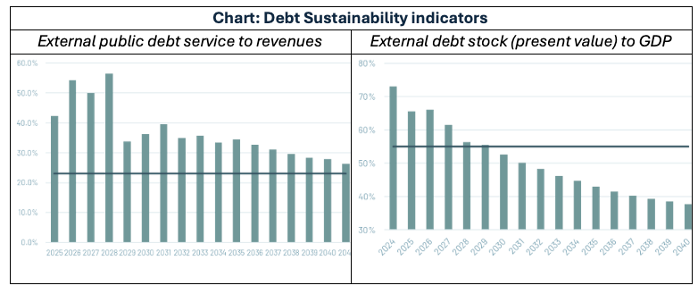
Second, finding cheap financing is difficult. The IMF is key here: it provides budget support at a 0% interest rate, and it unlocks budget financing from other (bilateral and multilateral) institutions. Obtaining an IMF program would require convincing the IMF that debt is sustainable, but the criterions as part of its Debt Sustainability Analysis it uses make it very unlikely. Under a realistic scenario, external debt service to revenues is above 50% from 2026 to 2028, where the level deemed “safe” is 23%. It stays above that threshold for the entire projection period, until 2040. Other options would be to turn to generous bilateral lenders, but few would be willing to take such risks in the long run without major compensations, such as privatizations (or land sales, like in Egypt).
If debt treatment is pursued, the central lesson from recent crises is to aim for an early and comprehensive resolution, rather than “too little, too late.” A key strategic choice in this path is the debt restructuring perimeter: preserving domestic-currency liabilities held within WAEMU is not merely a distributional preference; it is rather a macro-financial imperative to prevent regional contagion and a broader credit crunch that would ultimately worsen outcomes for Senegal and its external creditors.
To work, such a strategy will require support from international partners: the two main bilateral creditors, France and China, should commit, at a high level, to deliver fast and comprehensive debt treatment from the official sector, to unlock IMF financing, using procedural innovations introduced recently.
It should also implicate the private sector as early as possible. This treatment should be a test of the Common Framework's ability to deliver. The IMF should design its program to limit the impact on essential spending, including investment in human capital, priority infrastructure and security.
Restructuring public debt is never easy and creates considerable uncertainties, but it can lead to recovery. This would lead to a rating in “default” by rating agencies, and a temporary exclusion from the Eurobond market, but those ratings are lifted relatively rapidly if the debt treatment is deep enough and restores future prospects (as was the case in Ghana). During those negotiations, Senegal would be eligible for budget support from the IMF (under the “lending into arrears” policy) and other multilateral institutions.