

Two months after the Middle East war outbreak on February 28th, what are the wider impacts on developing countries beyond the region? Policymakers are concerned about severe effects such as fuel shortages, limited access to fertilisers and possibly food, along with implications for social and political stability. Expectations include impacts on oil prices, inflation, economic growth, and financial conditions. Yet, after a brief period of stress, financial markets in both advanced and emerging economies, including stocks and bonds, have mostly rebounded to pre-crisis levels. Adam Tooze described this peculiar world as “complacency, escapism and cognitive dissonance”, resembling a Rashomon-like reality.
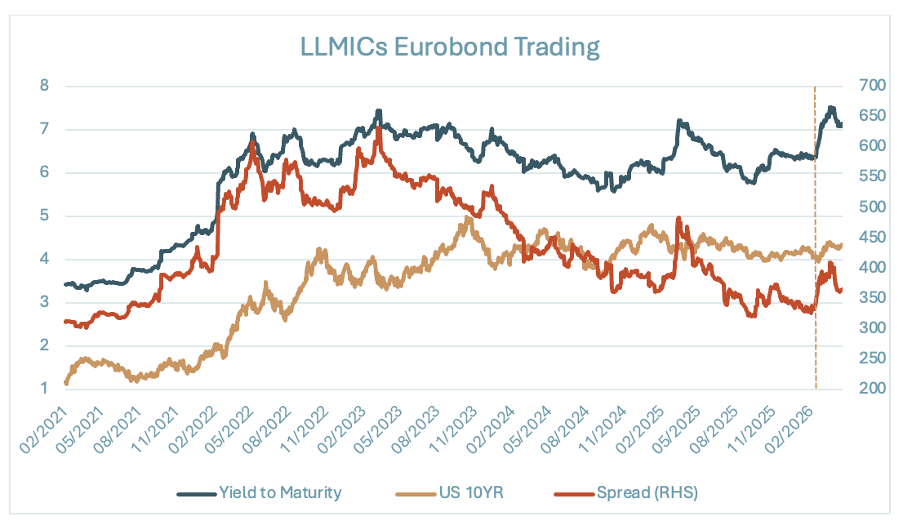
What about the debt of developing countries, especially frontier markets[1]? Following the Russian war in Ukraine and the subsequent global rate tightening cycle, they had suffered a prolonged decline in prices, shunting many countries out, and pushing interest rates high for those that could borrow. In 2025 and 2026, a different cycle, marked by a weaker dollar, strong risk appetite, and improving fundamentals, supported the view that frontier markets were becoming a more resilient asset class that LLMICs could sustainably rely on to access international capital. So how has this narrative held up in the context of the war so far?
The cost of financing for frontiers initially increased sharply, reaching their highest levels in recent history before retracting. Average yields on 10-year Eurobonds reached 7.53% on the 27th of March 2026, before retracing to around 7.15%, still roughly 30 bps above pre-war levels. The 7% threshold remains symbolically high, having been breached only briefly during the 2023 rate shock and the April 2025 tariff episode. Sustained levels at or above this threshold would materially increase debt-servicing costs, potentially adding hundreds of millions of USD annually.
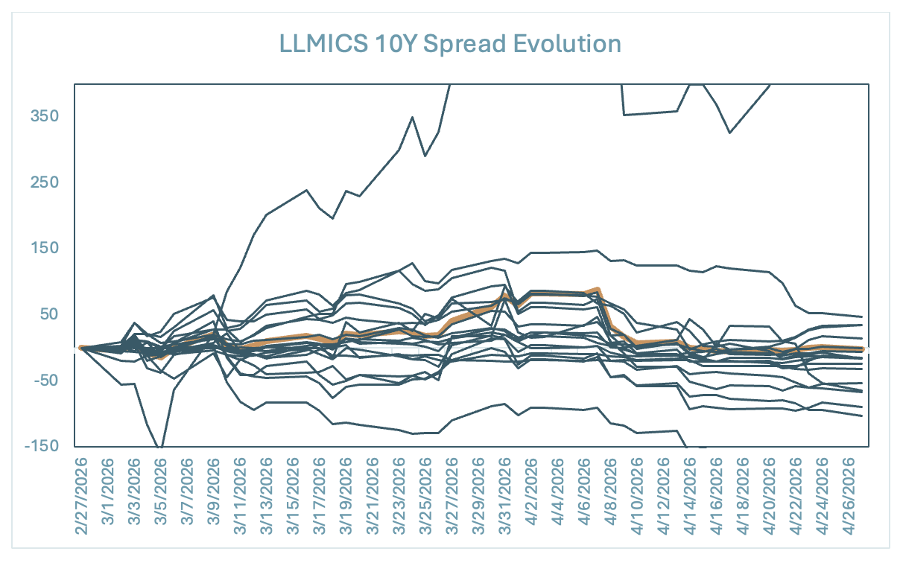
However, the key takeaway lies in the decomposition: the increase in yields has been driven primarily by the risk-free rate rather than by credit spreads. Spreads had widened before the beginning of the war for reasons apparently unrelated[2]. They also reacted to the war shock initially by widening by 45 bps but quickly retraced in the first week of March to around 360 bps, below pre-war levels and close to historical lows. Meanwhile, benchmark rates, which were tightening pre-war, increased by roughly 20 to 40 bps. They remain at this higher level so far (for example, the 10-year US treasury is currently priced at 4.33%). In other words, markets have repriced duration, not credit risk. So far, the war has not reversed the structural spread-tightening trend in frontier spreads observed over the past three years.
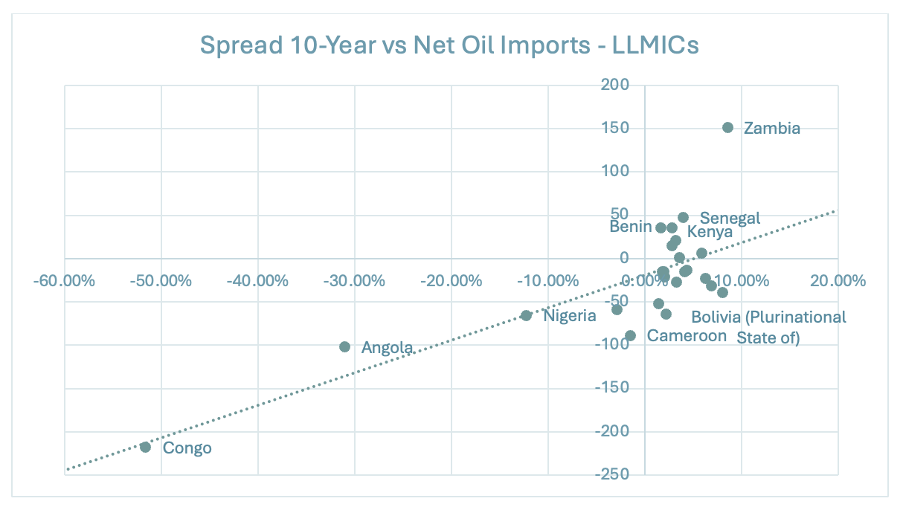
At a more granular level, dispersion across countries highlights the market’s discriminatory function. Spread performance has been closely linked to exposure to the shock, particularly for oil-exporting countries. There is a clear positive correlation between net oil exports and spread tightening (R² = 0.6), confirming that markets are pricing fundamentals rather than engaging in indiscriminate risk-off behaviour. Oil exporters significantly outperformed, with Congo (-218 bps), Angola (-102 bps), and Cameroon (-89 bps), experiencing the most significant spread decrease. However, the correlation is not clear-cut for oil-importing countries, as the market does not seem to price in credits for oil exposure. Zambia is the biggest importer of this sample and is recording the most important widening (+150 bps).
But aside from this country, the main underperformers are Senegal (+50 bps), Kenya (+35 bps), and Benin (+35 bps). They are all oil importers but report less exposure than countries that have tightened, such as Honduras, Laos, Tunisia, Rwanda, or Pakistan.
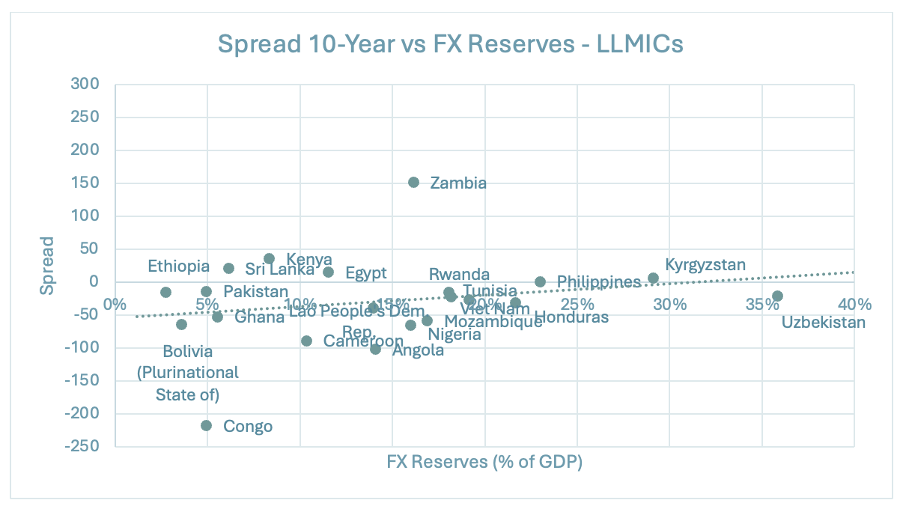
FX reserves do not seem to be a relevant factor in explaining the evolution of the spread during the war. There is no clear correlation and a very low R-square (0.04) when comparing FX reserves (% GDP) versus spread evolution.
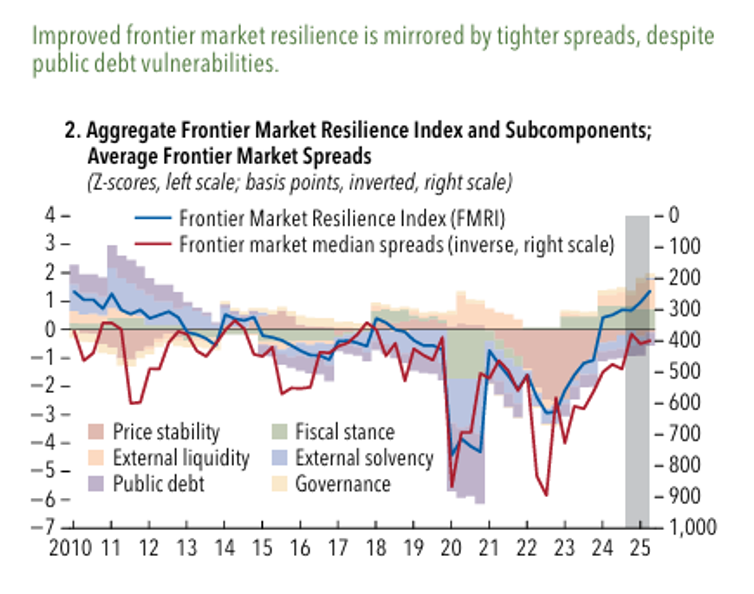
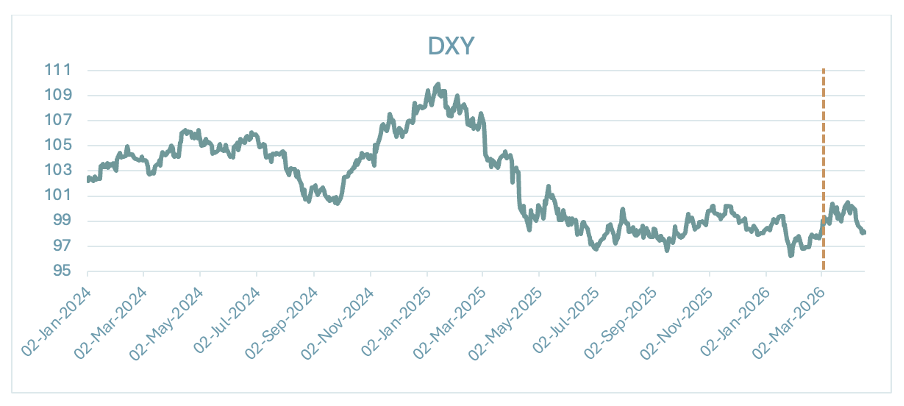
Explanation for this resilience may lie in a combination of improved national fundamentals and cyclical factors. As pointed out in a recent IMF publication[3], the macroeconomic fundamentals of frontier countries have historically been closely correlated with spreads. Recently, an index built by the IMF recorded significant improvement in the fiscal stance, price stability, external liquidity, and governance. This may reinforce market participants’ sentiment towards the asset class. Another possible explanation, this time independent of policymakers in LLMICs, is the direction of the US Dollar. Despite the crisis, the DXY, an index tracking the US Dollar versus a basket of currencies, has remained at levels similar to those of the past 18 months, which helped fuel the rally throughout 2025.
The frontier asset class has so far passed this stress test, with spreads remaining broadly resilient and market dynamics reflecting a selective, country-specific repricing rather than a generalised risk-off episode. Overall, the episode suggests that improved macro fundamentals and supportive external conditions have, for now, helped anchor investor confidence in the asset class. That said, risks remain tilted to the downside: yields are still hovering near cycle highs, which is likely to exert sustained pressure on debt sustainability, while primary market access, although still open for some issuers such as Angola and the DRC[4], comes at elevated costs in the 9–10% range. In addition, the potential transmission of the conflict to the real economy could gradually feed into sovereign credit risk. Should these factors materialise more forcefully, the current resilience in spreads may ultimately prove temporary.
[1] The frontier market is defined here as Eurobonds issued by sovereign in the low income and lower middle-income bracket as per World Bank classification. Countries included are Angola, Bolivia, Cameroon, Sri Lanka, Congo, Benin, Ethiopia, Ghana, Honduras, Côte d'Ivoire, Lao People's Dem. Rep., Mozambique, Nigeria, Pakistan, Philippines, Rwanda, Senegal, Viet Nam, Tunisia, Egypt, Zambia, Kenya, Uzbekistan, Kyrgyzstan.
[2] Anticipation effects are not visible in others similar assets such as for Upper Middle-Income Countries.
[3] April 2026 Global Financial Stability Report : Global Financial Markets Confront the War in the Middle East and Amplification Risks
[4] During the peak of the turmoil the Republic of Angola was even allowed to issue a dual tranche USD 2033 / 2037 - 9.375% / 9.875 % demonstrating that primary market could remain opened for some sovereigns. Even more impressive, the Democratic Republic of Congo was also able to conduct its inaugural issuance of a dual tranche USD 2032 / 2037 – 8.750% / 9.500%.