

JOINT FDL/SHANGHAI INSTITUTE FOR INTERNATIONAL STUDIES WORKSHOP
Sustainable Development Finance in a Fragmented World:
Challenges and the Way Forward
Shanghai, 4-5 December 2025
Experts and scholars from China, France, the United States, Sri Lanka, South Africa, and other nations, along with representatives from international organizations such as the Asian Infrastructure Investment Bank (AIIB), the New Development Bank (NDB), the Asian Development Bank (ADB), and the United Nations Economic Commission for Africa (UNECA), convened to discuss sustainable development finance in the Global South.
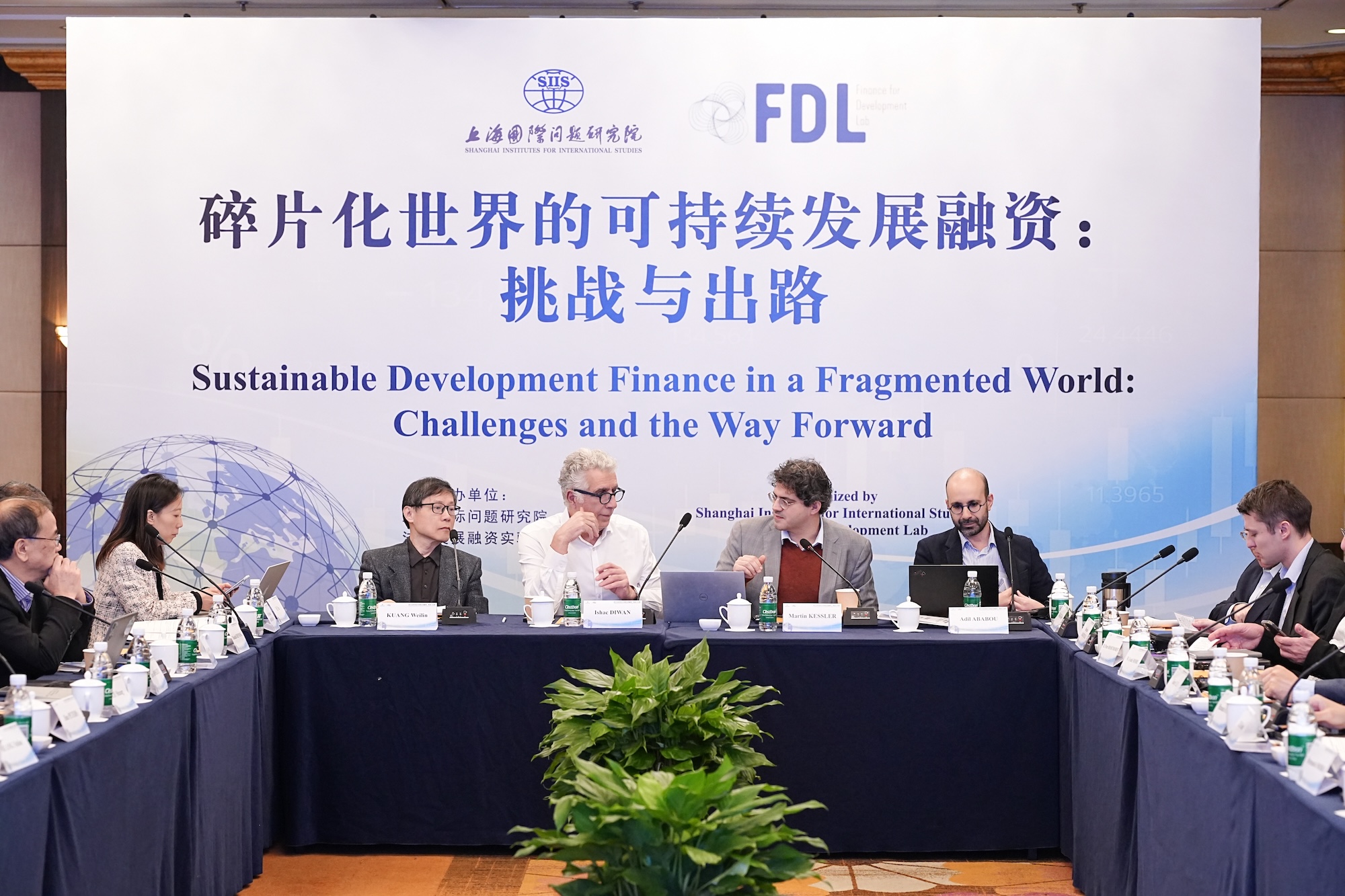
Topics included debt sustainability analysis, sovereign debt risk management, coordination mechanisms for debt restructuring, and global financial governance. The event provided a platform to exchange high-quality academic research and policy insights on development finance and global governance. At the opening session on the morning of 4 December, Martin Kessler, Chief Executive Officer of the Finance for Development Lab, and Ye Yu, Deputy Director of the Institute of World Economy at SIIS, delivered opening remarks.
They noted that amid accelerating adjustments in the global political and economic landscape, rising risk spillovers, and increasing fragmentation, development finance faces new uncertainties and structural constraints. Addressing the urgent needs of countries in the Global South for sustainable growth and a green transition requires more inclusive and resilient frameworks for international cooperation.
Keynote speeches were delivered over the two-day conference. On the morning of 4 December, Vera Songwe, Chair and Founder of the Liquidity and Sustainability Facility (LSF) and former Executive Secretary of UNECA, delivered a keynote address sharing her observations on pathways to better link global liquidity support with sustainable development finance. Erik Berglof, Chief Economist of the Asian Infrastructure Investment Bank, offered recommendations on the role of multilateral development banks in closing development finance gaps, improving investment efficiency, and promoting regional connectivity.
On the morning of December, Ishac Diwan, Research Director of the Finance for Development Lab, and Martin Kessler discussed the current state of the debt crisis in developing countries. They examined the changing challenges of sovereign debt in Africa, starting with issues like illiquidity, financial leakages, and high borrowing costs that continue to strain government budgets. The discussion then focused on the increasing insolvency problems across the continent and evaluated how the G20 Common Framework operates in practice, including its limitations and what debtor countries expect.
The conference featured six thematic sessions:


Session I: “Sustainable Development Finance: Adapting to the New Reality”
This session focused on key challenges and opportunities in sustainable development finance for Global South, aid modalities, and industrial promotion. It also examined the impact of South–South cooperation on coordinating climate investment and discussed the evolution of China’s state-supported lending and co-financing mechanisms, alongside strategies used by multilateral development banks.
Teal Emery, Founder and Chief Researcher of Teal Insights, presented a paper entitled “Is the Grass Greener on the Other Side? Mapping China’s Overseas Co-financing and Financial Innovation.” Liu Shuang, Senior Research Fellow and Director of the Sustainable Finance Center at the World Resources Institute, presented “Reconstructing Development Finance through South–South Cooperation and Climate Action.” Wang Qizhi, Associate Professor at the Central University of Finance and Economics, presented “China-style Structural Transformation: Development Stages and the Interaction with Aid Effectiveness.”
Zhang Chun, Research Fellow at the Center for African Studies of Yunnan University, and Dan Peters, Senior Advisor on Development Finance at the Gates Foundation, joined the discussion. The session was moderated by Qiao Yide, Vice President and Secretary-General of the Shanghai Development Research Foundation. Participants agreed that, amid tightening external financing conditions and rising risk premia, the Global South needs to strengthen institutionalized cooperation and project implementation capacity to enhance the accessibility, coordination, and effectiveness of green investment and energy transition finance.
Session II: “Improving Debt Sustainability Analysis (DSA): Technical and Political Economy perspectives”
This session explored how countries in the Global South can improve their own debt sustainability analysis to supplement international evaluations, along with the influence of geopolitical factors on differences among institutional assessments.
B. Peter Rosendorff, Professor of Politics at New York University, presented “The Geopolitical Logic of Debt Sustainability Analysis.” Rick Rowden, Senior International Policy Advisor at the Bread for the World Institute, presented “Improving Debt Sustainability Analysis: How Can Progress Be Made?” Ka Lok Wong, Economist at UNECA, presented “Supply-side Determinants of Sovereign Debt Auctions in Emerging Markets.”
The discussion featured Wang Wen, a Professor at the University of International Business and Economics and former Chief Economist of Sinosure; Théo Maret, an Investment Analyst at Mesarete Capital; and Bruno Cabrillac, a former official at France's Banque de France's Economics and International Relations Directorate. Huang Meibo, Dean of the Institute of International Development Cooperation at Shanghai University of International Business and Economics, moderated the session. Participants highlighted that improving data transparency and methodological consistency is vital for better debt sustainability analysis, while also recognizing political economy constraints that cause divergences and spillover effects. They called for more comparable and practical assessment tools to enhance governance.
Session III: “Sovereign Debt Risk Management: Debt Composition, Currency Denomination, and Others”
This session addressed strategies for emerging markets and developing economies to enhance foreign-currency bond issuance amid volatile financial conditions. It also explored balancing debt sustainability with economic resilience, evaluating the role of local-currency lending instruments from multilateral development banks, and learning from China’s approach to resolving local government debt issues.
Ma Hongfan, Director of the Financial Research Center at the Chinese Academy of Fiscal Sciences, presented “Lessons from China’s Experience in Resolving Local Government Debt.” David Vavra of OGResearch presented “Hedging Foreign-Currency Public Debt Risk: A Countercyclical Shock-Absorbing Mechanism?” Xu Jiajun, Tenured Associate Professor at Peking University, presented “Local Currency Lending by Multilateral Development Banks.” Niccolo Rescia, expert at Global Sovereign Advisory, introduced the “New African Debt Database.” Layna Mosley, Professor at Princeton University, presented “Creditor Composition, Default Risk, and Financing Channels.”
Tang Xiaoyang, Chair of the Department of International Relations at Tsinghua University, participated in the discussion. The session was led by Wang Yuzhu, Executive Director of the Center for World and Shanghai Studies at SIIS. Participants concurred that improving debt structures and promoting innovation in local-currency financing can strengthen fiscal resilience, but these efforts should be combined with macroeconomic policy coordination, financial infrastructure enhancement, and increased debt transparency.
Session IV: “Creditors’ Coordination in Sovereign Debt Restructuring: Role of the G20, the Paris Club, and the New ‘London Club’”
This session discussed progress and challenges related to the G20 Common Framework and the functioning of the Sustainable Debt Solution Bondholders’ Alliance (SDSB).
Huang Yufan, PhD candidate at the China–Africa Research Initiative of Johns Hopkins SAIS, presented “China’s View of the Common Framework: Progress and Challenges.” Fernando Morra, Researcher at the International Institute for Sustainable Development, presented “Letting a Thousand Flowers Bloom: Designing Debt Relief in a Fragmented Creditor Landscape.” Sun Tianshu, PhD candidate at the School of Public Policy and Management at Tsinghua University, presented “Debt-for-Development in China: Progress and Analysis.”
Benjamin D’Artevelle, Secretary General of the Paris Club, and Sonja Gibbs, Managing Director of Sustainable Finance at the Institute of International Finance, participated in the discussion. Adil Ababou, Senior Program Officer for Development Policy and Finance at the Gates Foundation, moderated the session. Participants highlighted that diversifying creditors requires enhanced coordination and trust in information sharing. They also suggested that the Common Framework could become more practical by improving procedural procedures, ensuring treatment comparability, and fostering innovation in financial instruments.
Session V: “Innovative Sovereign Financing and Debt Restructuring Practices: Lessons from Sri Lanka and Kenya, etc."
This session reviewed multilateral restructuring practices, the introduction of new financing tools, adjustments to debt maturities and interest rates, constraints from structural reforms, and external debt currency conversion and risk management.
K. M. Mahinda Siriwardana, Alternate Executive Director for relevant constituencies at the Asian Development Bank, and Thilina Panduwawala, Senior Advisor to the Parliamentary Committee on Public Finance of Sri Lanka, delivered presentations. Participants in the discussion included Kangyi Lü, Partner at Pincent Masons; Chen Boyu, Head of the International Projects Department at China International Engineering Consulting Corporation; Hannah Ryder, Founder and CEO of Development Reimagined; and Syed Javed Hassan, Senior Visiting Scholar at the Pakistan Study Centre of Fudan University. The session was moderated by Kuang Weilin, former Chinese Ambassador to Sierra Leone and the African Union. Participants agreed that innovative restructuring and financing instruments can create fiscal space, but long-term recovery ultimately depends on restoring industrial ecosystems, strengthening governance capacity, and stabilizing expectations in the external financial environment.
Session VI: “Broader Global Financial Governance for Sustainable Development”
This session examined ways to create a more inclusive and resilient global financial system by reforming financial regulations, renewing multilateral institutions, restructuring the debt framework, and developing innovative financing tools.
Speakers included W. Gyude Moore, Distinguished Fellow at the Energy for Growth Hub and former Minister of Public Works of Liberia; Randall Henning, Professor at American University; Zhuang Juzhong, Adjunct Professor at Fudan University’s International School of Finance and former Deputy Chief Economist of the Asian Development Bank; Li Xiaowei, Deputy Director-General of the Strategic Planning Department at the Export-Import Bank of China; Qian Jing, Assistant Professor of Political Science at NYU Shanghai; and Zhang Youyi, Deputy Division Director at the China International Development Knowledge Center of the Development Research Center of the State Council. The session, led by Zhu Jiejin, a Professor at Fudan University and Deputy Director of the Center for UN and International Organization Studies, highlighted the need for improved global financial governance to support sustainable development. Participants stressed that achieving a better balance between international rules and national priorities is essential. They also called for multilateral mechanisms to enhance their effectiveness and credibility in areas such as resource mobilization, risk sharing, and standard alignment.