

AMPLIFYING AFRICA’S VOICES (AAV) DIALOGUE #20
Africa’s Exposure to the Middle East Conflict
Taking stock of the impact on the ground
By Sarah Lawan, Mathilde Barras and George Boateng

Hosted in partnership with the African Center for Economic Transformation (ACET)
The 20th Amplifying Africa’s Voices (AAV) dialogue was held on 28 April 2026 – two months after the start of the war in Iran – with the ambition to take stock of Africa’s exposure to the Middle East conflict.
Several reports have documented the potential impacts of the war on energy, fertilizers, and food prices, but data are slow to emerge. International press reporting has been useful but needs to be complemented by data and analysis from economists on the ground.
The first half of the dialogue had exactly this aim: to document on-the-ground expert reactions from 10 Africa-based policy institutes across eight countries. We do not claim that those countries are representative of the continent, but they allow us to describe the pathways of the shock.
All are exposed to the same channels of impact: rising energy prices, vulnerable food security, disrupted trade routes, and inflationary pressures. Policy responses vary: some allow inflation to rise, while others try to compensate through subsidies or tax relief on key items to help contain inflation. The signs are visible, and the scarring effects will persist. This table summarizes the view from each institute, but a few general messages can be highlighted:
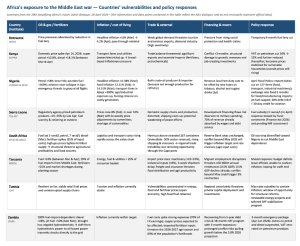
- Africa’s domestic fuel markets are under pressure: Because more than half of the continent's total energy supply comes from fossil fuels, Africa remains highly vulnerable to energy price shocks. Net importers have faced large increases in petroleum prices, ranging from 10% to 50%. Some fuel exporters have benefited, but even Nigeria suffers from shortages of certain fuels, such as kerosene, forcing the government to curtail flights and cap prices.
- Africa’s economic landscape is severely affected by the conflict: The regional economy is facing a “perfect storm” of compounding shocks. High food inflation remains the primary concern, as supply chains for fertilizers and edible oils are disrupted. These pressures are exacerbated by exchange-rate volatility in some countries.
- African resilience stands at a crossroads: The policy response has varied; central banks are still assessing the persistence of those effects and have not yet raised their rates. In most countries, fiscal measures, including temporary tax relief and targeted subsidies, helped support households at the cost of higher deficits. Fiscal resilience could be nearing its limit and may require much more proactive external support. A prolonged conflict threatens to exhaust remaining policy toolkits, potentially leading to a broader regional downturn as governments lose the capacity to intervene.
The second half of the meeting took the form of a dialogue on practical policy recommendations to reduce external vulnerabilities and fortify African economies against a protracted global crisis. Three guests were invited to share their insights on the matter:
- Mbuyamu Matungulu (Former Minister of Economic Affairs, Finance, and Budget of the DRC, former Executive Director at the AfDB and Alternate Executive Director at the IMF)
- Raymond Gilpin (Chief Economist and Head of the Strategy, Analysis and Research Team at the Regional Bureau for Africa, UNDP),
- Amadou Sy (Assistant Director & Division Chief, African Department—Regional Studies, IMF).
Other participants included:
- Kedibonye Thompson, BIDPA – Botswana Institute for Development
-
Adan Shibia, KIPPRA – Kenya Institute for Public Policy Research and Analysis
- Olaniyi Yusuf, Verraki (Nigeria)
- Wilson Erumebor, NESG – The Nigerian Economic Summit Group
- Abou Bakarr Kamara, IGC – The International Growth Centre (Sierra Leone)
- Nomahlubi Jakuja, SPI – Social Policy Initiative (South Africa)
- Priyal Singh, ISS Africa – Institute for Security Studies Africa (South Africa)
- Jamal Msami, REPOA (Tanzania)
- Aram Belhadj, GI4T – Global Institute 4 Transitions (Tunisia)
-
Margret Mbewe, ZIPAR – Zambia Institute for Policy Analysis and Research
The conflict, occurring amid aid cuts and US tariffs, is testing the recent macroeconomic progress on the continent, particularly in growth and inflation control. Even if hostilities cease immediately, the long-term economic scarring on productivity and fiscal health remains a primary concern. Therefore, speakers advised a scenario-based policy approach that would be structured around: evidence-based monetary adjustments rather than broad-stroke reactions, as well as targeted fiscal interventions supporting the most vulnerable populations to preserve fiscal space rather than blanket subsidies. Well-crafted policies could help Africa turn this challenge into an opportunity toward: maintaining macroeconomic stability with adequate fiscal responses, exploiting underutilized domestic resources (such as urea and potash) to strengthen economic sovereignty, honoring global debt commitments (including suspending service payments during severe exogenous shocks), and accelerating the implementation of the AfCFTA (by removing both tariff and non-tariff barriers).
The succession of global crises, such as COVID-19, the war in Ukraine, and tensions in the Middle East, demonstrates that we have entered a period of permanent uncertainty (geopolitical tensions, economic and global trade disruptions). These shocks are not temporary but are becoming Africa’s new normal. The question is not so much whether there will be a crisis anymore but rather when it will hit.
Hence the importance of contingency planning as a necessary transition from emergency response to a routine component of the policy toolkit. Speakers underlined the structural shifts required in that regard: implement a medium- to long-term economic policy framework that prioritizes macroeconomic stability; improve governance to boost investment and economic confidence; integrate specific, predefined contingency actions within national budgets to counter the negative repercussions of unforeseen shocks.
It is now crucial to look beyond the war and beyond the shocks. Speakers emphasized the urgent need to translate political will into the operationalization of the Africa Stabilization Fund and to build a regional approach to social protection to shield the most vulnerable from trade supply disruptions. They also argued that resilience must be anchored in medium-term structural improvements, for example, in the fields of governance of state-owned enterprises, fiscal transparency, regional integration, digitalization of the economy, and domestic financial markets.
Key takeaways:
-
Preserve macroeconomic stability without overreacting
Governments should preserve macroeconomic stability through scenario-based policy responses that distinguish temporary shocks from persistent inflationary pressures.
-
Replace blanket subsidies with targeted protection
Fiscal responses should shift from blanket subsidies to targeted support for vulnerable households and firms.
-
Strengthen regional supply-chain resilience through AfCFTA
Countries should use the AfCFTA as a resilience tool to expand trade and deepen regional value chains for food, fertilizers, and essential goods.
-
Build domestic and regional capacity in critical inputs
African governments and regional institutions should build domestic and regional capacity for critical inputs, including fertilizers, edible oils, and energy-related products.
-
Operationalize regional stabilization and contingency financing
African institutions and development partners should accelerate the operationalization of the Africa Stabilization Fund and set clear triggers for emergency liquidity support and debt-service relief during severe external shocks.